


 Jul 14, 2026
 8 min
8 minEquipment reservation app: prevent conflicts and track returns
Plan an equipment reservation app that prevents double bookings, records returns and damage, and places faulty items on maintenance hold.

Discover the symbiotic relationship between low-code platforms and cloud computing technology, driving innovation, agility, and time-to-market in software development.

Low-code platforms provide a visually-driven approach to designing, developing, and deploying software applications, reducing the reliance on traditional hand-coding techniques. They offer drag-and-drop functionalities, pre-built components, and reusable templates. Therefore low-code platforms empower developers to create maintainable and scalable applications with minimal coding effort. These platforms have become a game-changer in the software development industry, addressing the growing demand for agility and time-to-market.
Key characteristics of low-code platforms include:
Cloud computing is a paradigm shift in IT infrastructure management, delivering on-demand resources and services over the internet as-needed. By adopting cloud infrastructure, businesses can effectively address a wide array of operational challenges, such as high costs, complex maintenance, and scalability limitations associated with traditional on-premises systems.

Essential characteristics of cloud computing include:
The integration of low-code platforms and cloud computing technologies creates a powerful symbiosis that revolutionizes the way software applications are designed, developed, deployed, and managed. By combining the inherent advantages of both approaches, developers can build, deploy, and scale cloud-based applications swiftly, efficiently, and with minimal coding effort.
Key benefits of the low-code and cloud computing synergy include:
Low-code platforms allow visual design and implementation of application components, while cloud computing provides instant provisioning and on-demand resources. This combination enables rapid development, testing, and deployment of applications, significantly reducing time-to-market.
With low-code platforms, developers can create applications using pre-built components and templates, minimizing the need for custom code and reducing development efforts. Coupled with the pay-as-you-go pricing model of cloud computing, this approach results in substantial cost savings.
Both low-code platforms and cloud computing are inherently scalable, ensuring that the applications can effortlessly grow and adapt to changing business requirements and workloads.
Low-code platforms enable seamless collaboration between development teams, while cloud computing ensures ubiquitous access to application resources. This fosters shared ownership, transparency, and rapid iterations during the development process.
By generating applications from scratch every time requirements are modified, low-code platforms like AppMaster.io eliminate technical debt and ensure that the applications remain aligned with the latest standards and technologies.
AppMaster.io is a powerful no-code platform designed to revolutionize the way developers approach backend, web, and mobile application development. Founded in 2020, the platform aims to make app development faster, more efficient, and cost-effective across various industries and use-cases. AppMaster.io is already trusted by more than 60,000 users as of April 2023.
The platform's central tenet revolves around bridging the gap between coding and visual design, enabling developers to create visually-designed data models, business processes, REST API, and WebSockets (WSS) endpoints without writing a single line of code. AppMaster.io leverages the power of modern development frameworks such as Go (backend applications), Vue3 (web applications), Kotlin and SwiftUI (mobile applications) to provide unparalleled resource efficiency and performance in the resulting applications.
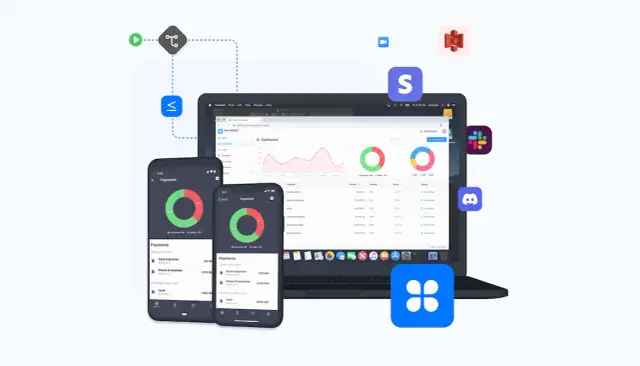
One of the platform's key differentiators lies in its ability to regenerate applications from scratch whenever requirements or business logic change, thus eliminating technical debt and ensuring that applications stay in sync with the latest standards and technologies. With six types of subscriptions available, AppMaster.io caters to a broad range of customer needs and budgets. The assortment of subscription plans serves customers from individual enthusiasts to large enterprises.
Utilizing AppMaster.io's no-code capabilities for cloud computing results in promising outcomes for businesses needing to build robust applications in a fraction of the time typically required. Cloud computing's versatility results in a perfect match for the quick prototyping and iterative nature of low-code development. With cloud computing's flexible infrastructure, reduced costs, and on-demand resources, AppMaster.io enables rapid deployment and scaling of applications onto various cloud platforms.
Upon the completion of the visual design process, AppMaster.io generates source code and compiles applications, executes tests, bundles the applications into Docker containers, and deploys them to the cloud. Managing deployments is efficient and worry-free, ensuring that businesses can stay focused on core functions rather than infrastructure management. Cloud-based application development with AppMaster.io streamlines teamwork and collaboration, enabling remote developers to work simultaneously while also enhancing security and performance.
On top of that, AppMaster.io applications are compatible with any PostgreSQL-compatible database as their primary data storage, opening up opportunities for flexible system integration, robust data management, and seamless data migrations.
Technical debt, an ever-present bane in software development, can arise from various factors such as inadequate design, hastily written code, outdated dependencies, or not following best practices. As a project evolves, a failure to address technical debt can degrade the performance, maintainability, and extensibility of the software. Being critical to organizational success, especially in agile methodologies, tackling technical debt is a concern for both the development team and wider organization.
Luckily, low-code and no-code platforms like AppMaster.io have emerged as valuable tools in mitigating this challenge. No-code platforms like AppMaster.io and cloud computing share a common characteristic in their ability to minimize technical debt. Powerful visualization and automation capabilities provided by low-code platforms enable developers to generate clean and efficient code that adheres to best practices. By substantially reducing the need for manual coding, low-code platforms make it easier and faster to refactor code, eliminate redundancies, and ensure that the software aligns with the latest industry standards.
AppMaster.io makes it possible for organizations to resolve the problem of technical debt by automating aspects of the development process, such as generating applications from scratch at every update, running tests, and deploying to the cloud. As a result, the platform helps to maintain clean, optimized, and well-implemented code that meets industry standards, reducing the risks of technical debt in applications.
The automation and visualization capabilities provided by low-code and no-code platforms such as AppMaster.io enable clean application development from the ground up, ensuring that the generated applications minimize technical debt. Here's how:
The combination of low-code platforms and cloud computing enriches the development process by accelerating the development and deployment of applications.
The relationship between low-code and no-code platforms like AppMaster.io and cloud computing is a powerful combination that reduces technical debt, streamlining software development processes and accelerating application delivery. As the demand for software solutions continues to grow, the alliance between low-code platforms and cloud computing will become even more significant in the coming years, empowering the development of efficient and scalable applications.
 What is the relationship between low-code platforms and cloud computing?
Low-code platforms and cloud computing technologies are complementary, enabling developers to build, deploy, and scale applications swiftly, efficiently, and with minimal coding effort. The combination of these approaches streamlines software development, reduces technical debt, and accelerates time-to-market.
How do low-code platforms benefit from cloud computing?Low-code platforms leverage cloud computing resources for rapid application development, deployment, and scaling. Utilizing cloud-based infrastructure allows quicker time-to-market while reducing the burden on internal IT resources.
What are the key advantages of cloud computing in low-code app development?Key advantages include on-demand resources, self-service provisioning, reduced infrastructure costs, elastic scalability, and enhanced collaboration among development teams.
How does AppMaster.io facilitate cloud-based application development?AppMaster.io is a powerful no-code platform that allows building, deploying, and scaling web, mobile, and backend applications in the cloud. The platform's visual design approach and automated source code generation and deployment streamline the development process, reduce technical debt, and accelerate time-to-market.
What types of applications can be built using AppMaster.io?AppMaster.io caters to a broad range of application types, including web apps, mobile apps (iOS and Android), and backend applications with visually designed data models, business processes, REST API, and WSS Endpoints.
Can AppMaster.io applications be hosted on-premises?Yes, AppMaster.io applications can be hosted on-premises with the Business and Business+ subscription plans, which provide executable binary files, and the Enterprise subscription plan, which offers the source code for applications.
How does AppMaster.io enhance scalability and flexibility through integration?AppMaster.io generates stateless backend applications using Go, providing seamless scalability for enterprise and high-load use cases. AppMaster applications support PostgreSQL-compatible databases as the primary database, fostering flexibility and interoperability.
How does AppMaster.io address technical debt?AppMaster.io eliminates technical debt by regenerating applications from scratch whenever requirements are modified, ensuring that the applications remain in sync with the latest standards and technologies.
Experiment with AppMaster with free plan.
When you will be ready you can choose the proper subscription.
 Jul 14, 20268 min
 Jul 13, 20268 min
 Jul 08, 20268 min