


 Jul 14, 2026
 8 min
8 minEquipment reservation app: prevent conflicts and track returns
Plan an equipment reservation app that prevents double bookings, records returns and damage, and places faulty items on maintenance hold.

Discover the key factors for selecting the perfect low-code platform tailored to your business needs with considerations like cost, scalability, and ease of use.

A low-code platform (LCP) is a software development environment designed to facilitate the rapid creation of applications with minimal manual coding. LCPs primarily target developers by providing graphical user interfaces, drag-and-drop components, and pre-built templates to accelerate the development process. They allow developers to create applications by using visual tools and readily available components rather than writing extensive lines of code.
Low-code platforms can serve as a game-changer for businesses of all sizes, as they allow organizations to rapidly build and deploy software solutions with minimal investments in time, money, and human resources. They also provide a flexible approach to application development, enabling teams to adjust quickly in response to changing business needs and customer demands. LCPs offer a substantial competitive advantage in terms of agility, speed, and innovation, making them an appealing choice for companies seeking to maximize their software development capabilities.
Before evaluating low-code platforms, it is crucial to understand your business needs and requirements. Start by identifying the problems your organization aims to solve, the target audience for your applications, and the goals you hope to achieve with the help of the LCP. Consider factors such as:
By examining your specific needs and preferences, you can create a clear picture of the essential features and capabilities required in a low-code platform and ensure that your choice aligns with your business goals.
Once you have a clear understanding of your business needs, it's time to assess the features and capabilities of the low-code platforms you're considering. Here are some key features to look for:
By examining various low-code platforms' features and capabilities, you can ensure that the platform you choose will empower your team to develop and deploy the applications your business requires.
When choosing a low-code platform for your business, it is essential to consider its pricing model and total cost of ownership (TCO). You need to understand how much value you are getting from the platform and whether it fits into your organization's budget. Here are some critical aspects to consider when comparing pricing models:
Low-code platforms typically offer various subscription plans with pricing tiers corresponding to different sets of features and usage limits. Assess the available plans and choose one that covers your primary requirements without paying for unnecessary features that may drive up the costs.
Before committing to a specific platform, seek out a free trial or a proof-of-concept project to help you understand the true value of the platform in action. This provides an opportunity to evaluate the platform, explore its features and limitations, and identify any potential hidden costs you might encounter during actual implementation.
When comparing low-code platforms, always consider their total cost of ownership (TCO). Examine how the platform's features can impact your company's IT architecture, operational costs, and the cost of maintaining the platform in the long run. Account for aspects like:
Opt for low-code platforms that offer flexible payment options to suit your company's financial goals. For example, a pay-as-you-go pricing model can reduce upfront costs by charging based on actual usage. Examine the provider's payment terms and ensure they align with your company's budget and growth plan.

The low-code platform you choose should be capable of scaling and performing well under increasing workloads to match your business's growth. Consider these aspects when evaluating the scalability, performance, and security of a low-code platform:
Ensure that the platform has the ability to scale applications effectively, both vertically and horizontally, depending on your business's growth needs. The platform should provide high-performance applications that load quickly and work efficiently, meeting end-user expectations and avoiding detrimental system slowdowns.
Determine if the platform offers high availability and fault tolerance, ensuring that your applications continue operating even when some components or infrastructure fail. By mitigating downtime risks, the platform can ensure a seamless user experience that maintains customer trust.
A powerful low-code platform should have built-in security features, such as data encryption, user authentication, and access control, to protect sensitive information from potential threats. Assess the platform's built-in security features and explore its capacity to comply with your organization's security requirements and industry-specific regulations.
Choose a platform that conducts regular security audits and consistently updates its tools, infrastructure, and applications to address potential vulnerabilities. This proactive approach to security is essential for maintaining the highest level of protection for your low-code applications.
Integration and extensibility are crucial components of any low-code platform, especially as your business grows and requires connections to various systems and services. Keep these considerations in mind when evaluating integration and extensibility options:
A comprehensive low-code platform should have pre-built connectors and APIs that facilitate integration with various enterprise applications, databases, and systems. This capability allows you to quickly connect your low-code applications with existing infrastructure and services, creating a seamless and efficient environment.
The ability to create custom APIs and use them within your low-code applications is essential. This enables you to build custom integrations with external systems and services that might not have pre-built connectors, allowing for more extensive customization to suit your business needs.
Evaluate the platform's capacity to integrate with popular programming languages, such as JavaScript, Python, and Ruby, making it easier to introduce custom code when needed. The extensibility of the platform helps ensure that you can add custom features or tackle unique use cases without being limited by the platform's built-in functionalities.
Consider whether the low-code platform has integration capabilities with third-party marketplaces or plugins, enabling you to leverage pre-built features and templates that expedite application development. By using these pre-built resources, you can save time and resources while maintaining a high level of quality and functionality in your applications.
When evaluating low-code and no-code platforms, always consider the total cost of ownership, scalability, performance, security, and integration and extensibility options. This holistic approach ensures that you choose a platform that meets your business requirements and supports growth. A platform like AppMaster, with its broad feature set, cost efficiency, and scalability, could be an excellent choice to meet these prerequisites and improve the development process.
When evaluating a low-code platform, ease-of-use and a user-friendly experience should be high on your priority list. By selecting a platform with an intuitive interface and clear, efficient workflows, your team can comfortably create, update, and maintain applications without encountering unnecessary delays or steep learning curves. Consider the following factors when assessing ease-of-use and user experience:
A powerful community, support network, and thriving ecosystem are essential factors when choosing a low-code platform. Platform popularity and community size can be an indicator of a proven and reliable solution, while a diverse and active ecosystem can provide valuable resources, learning materials, and examples. Pay attention to these factors while researching community strength and ecosystem:
Selecting a low-code platform that is future-proof is essential for ensuring long-term success and adaptability for your applications. Technological advancements and evolving business requirements call for a flexible platform that can gracefully respond to change and accommodate varying needs. Here are some factors to consider when evaluating how future-proof a low-code platform is:
AppMaster is an outstanding example of a no-code platform that allows users to quickly and efficiently create backend, web, and mobile applications. With its easy-to-use and powerful no-code tools, AppMaster helps you visually design your applications without needing extensive programming expertise. It focuses on providing a seamless experience to its 60,000+ users by offering a comprehensive suite of tools designed to improve the process of building powerful software solutions.
One of the reasons why AppMaster stands out in the low-code domain is that it empowers users to create data models for backend applications visually, design business logic through its visual Business Process Designer, and develop REST API and WebSocket Server Endpoints. For web and mobile apps, AppMaster offers a versatile drag-and-drop interface, allowing you to easily create UI components and implement their corresponding business logic.
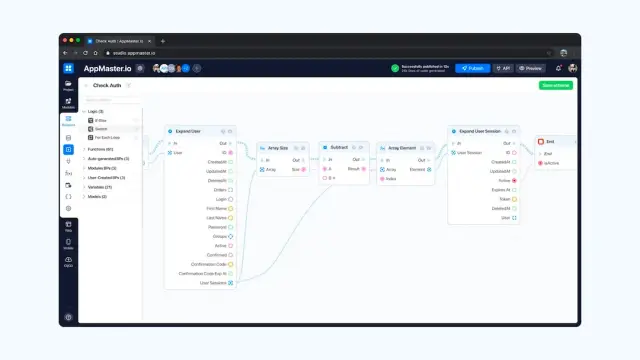
What sets AppMaster apart is its capability to generate source code for applications, compile them, run tests, and deploy to the cloud through its powerful platform. With the 'Publish' button, the platform handles all the complexities behind the scenes, ensuring that your applications are always up-to-date and ready for deployment in under 30 seconds. Some of the key features and benefits of utilizing the AppMaster platform include:
In addition to its existing features, AppMaster has been recognized by G2 as a High Performer in many categories like No-code Development Platforms, Rapid Application Development (RAD), API Management, Drag&Drop App Builders, API Design, and Application Development Platforms. Being named a Momentum Leader in No-Code Development Platforms is a testament to the innovation and quality AppMaster has brought to the market.
Choosing the right low-code platform for your business is a crucial decision that requires a thorough evaluation of your organization's specific needs and goals. By understanding your business requirements and carefully examining the various features, pricing models, scalability, performance, and integration capabilities of potential platforms, you'll be able to find the best solution for your organization. Remember to consider the platform's ease of use, user experience, community, and overall ecosystem as well to ensure a smooth and successful collaboration.
AppMaster can serve as a reliable and powerful no-code platform for businesses of all sizes and industries. With its versatile features, impressive scalability, comprehensive user experience, and solid performance, the platform helps users create a vast array of applications with minimal coding required. By using AppMaster for your project, you can significantly reduce development time and costs while still maintaining a high degree of customization, flexibility, and scalability.
When choosing the right low-code/no-code platform, always keep in mind your organization's long-term goals and objectives to ensure that you're making a well-informed decision. Don't be afraid to experiment with different platforms and leverage free trials or demos to find the best fit for your needs. With the right low-code platform at your disposal, you'll be well-equipped to meet your business's evolving demands and succeed in the digital age.
 What is a low-code platform?
A low-code platform is a software development environment that allows developers and non-developers to create applications with minimal manual coding, typically using graphical user interfaces, drag-and-drop components, and pre-built templates.
How do low-code platforms benefit businesses?Low-code platforms enable businesses to develop and deploy applications faster, save time and resources, improve collaboration, and offer flexible integration with other systems, making it cost-effective and efficient in addressing customer demands and business challenges.
What factors should be considered when choosing a low-code platform?Key factors to consider are business needs, platform features, pricing models, scalability, performance, security, integration options, ease-of-use, user experience, support, and the overall development ecosystem.
Are low-code platforms suitable for all industries and business sizes?Low-code platforms can benefit businesses of all sizes and industries by offering quick application development, flexible customization options, and low costs, making it a suitable option for a wide range of business requirements.
Can low-code platforms handle complex business logic?Yes, advanced low-code platforms can handle complex business logic through comprehensive visual tools, pre-built components, and integration options, allowing users to create tailored applications that address specific business needs.
What is the difference between low-code and no-code platforms?Low-code platforms primarily target developers and empower them to create applications with minimal manual coding, while no-code platforms are targeted towards non-developers and emphasize complete visual development without requiring any manual coding.
How do low-code platforms ensure application security?Reputable low-code platforms are built with security considerations in mind, providing secure development frameworks, built-in security features, and tools for regular application security checks and audits.
What are the potential downsides to choosing a low-code platform?Potential downsides may include limitations in customization and flexibility, vendor lock-in, or a steep learning curve for more advanced features. Thoroughly evaluating low-code platforms and considering the long-term needs of your business is essential to making the right choice.
How customizable are applications created using low-code platforms?The degree of customization depends on the specific low-code platform. Some platforms offer extensive customization options, allowing the creation of highly tailored applications, while others may have more limited options focusing on ease of use and fast deployment.
Experiment with AppMaster with free plan.
When you will be ready you can choose the proper subscription.
 Jul 14, 20268 min
 Jul 13, 20268 min
 Jul 08, 20268 min