


 Jul 14, 2026
 8 min
8 minEquipment reservation app: prevent conflicts and track returns
Plan an equipment reservation app that prevents double bookings, records returns and damage, and places faulty items on maintenance hold.

A no-code expert shares the journey in creating complex corporate applications using no-code platforms highlighting key strategies and tools
I have been developing using no-code tools since 1998. Yes, even back then, there was MS Access, which allowed you to create a small accounting system with multi-user access without programming. In the early 2000s, an application built on MS Access was operating in a dozen stores of a large home appliance and electronics retail chain (with over 50,000 SKUs). It handled inventory management, sales tracking, price control, and data exchange with other stores in the network to display stock levels. Overall, it's a good tool for quickly creating a database to manage any kind of enterprise data without programming, but with one drawback - it’s only accessible to users within the organization’s local network.
In recent years, many no-code tools have emerged, and there's even a whole no-code development industry now. However, most of these tools, unfortunately, are merely makeshift solutions for solving a specific task or are just geared towards simple web/mobile applications without complex logic.
No-code development allows for the rapid creation of complex applications for managing business processes within a company or interacting with customers while also reducing maintenance costs. Simply put, you can develop a custom CRM tailored to your business processes in just a month rather than having to adapt to a pre-built system.
However, it’s not just about building the application - you also need to maintain it. In a traditional application, a new developer (or even the original one) would have to spend time understanding the old code, reading through extensive documentation, and so on. With no-code, all the business logic of the application is edited through visual blocks, making it possible to understand what a process does in just a few seconds by looking at the business process diagram.
Carment, a fintech service created in partnership with Visa, is a prime example. It was developed on the no-code platform AppMaster, with integrations to several banks and KYC/KYB providers. All of this was achieved without writing a single line of backend code (the frontend was a traditional application built with VueJS). Developing the backend, setting up CI/CD, and deploying to Google Cloud servers took a little over 300 hours.
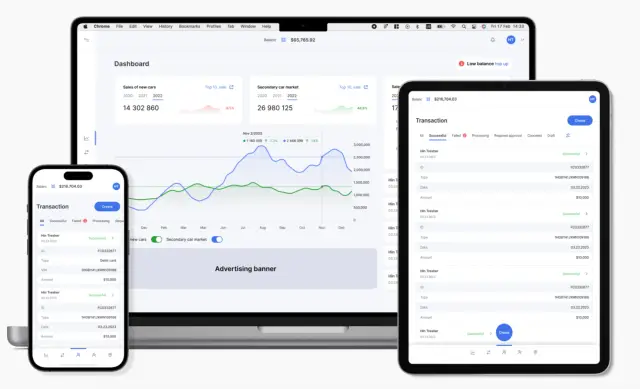
Another example is a management system for an outsourcing company, handling the records of hired workers, including their legalization data, project assignments, housing, corporate vehicles, and hours worked. This project’s backend and frontend were entirely developed on the AppMaster platform, taking around 200 hours. With my assistance, several complex projects have also been completed by individuals with little to no programming experience, taking about 1-2 months of learning during the development process.
In the professional no-code development market, several major solutions allow you to build complex applications:
I’ve explored and tested numerous no-code solutions, but ultimately, I settled on AppMaster because it covers all components of an application - backend, frontend, and mobile apps.
AppMaster allows you to publish your application on your own server by downloading the binary file or source code. The platform’s core feature is that it generates source code in Go for backend applications with every deployment. In case of unforeseen events, your operations won’t be disrupted if the application is hosted on your server and you have the source code, which can be modified if necessary.
The backend works with PostgreSQL, allowing you to leverage the full functionality of SQL queries, including JOINs, calculated fields, window functions, and more.
You can create fully functional web applications with custom designs (within reasonable limits) that you wouldn’t be embarrassed to present to clients and employees. For example, separate applications for client portals and employee tools. All of these will work together, and when you edit data models in the database, changes are instantly applied across the web versions.
The beauty of AppMaster’s mobile applications is that they don’t require updates in app stores. Every time the mobile app is launched, the latest configuration (screens and logic) is loaded. This means you only need to install the app on employees’ devices once, and all future changes will be applied automatically with each launch. There’s no need to go through the store moderation process again. Of course, this approach requires some compromise on app design, but it’s more than sufficient for corporate needs.
 What is no-code development?
No-code lets teams build custom business software through visual tools instead of writing every part by hand. It works well for apps with data, workflows, user roles, forms, and integrations.
Can no-code handle complex business applications?Yes. You can build internal tools, CRMs, customer portals, booking systems, sales tools, and process automation. The project still needs clear requirements and sensible data design.
Why build a custom CRM instead of using a ready-made one?A custom CRM can match your actual sales stages, fields, approvals, and reports. That saves your team from reshaping its process around a generic product.
Is a no-code app easier to maintain?Visual business process diagrams show the logic step by step. A new teammate can review the flow directly instead of tracing through old code and long technical documents.
How can no-code help a small company using Excel?Small companies can replace scattered spreadsheets with shared forms, records, and permissions. Staff enter data in one place, while managers can check operations from a browser or phone.
What can large companies build with no-code?Large teams can create apps for field staff, department data collection, internal workflows, and employee portals. Start with one process that causes repeated manual work, then expand from there.
Can I build a customer-facing app with no-code?No-code can support client portals, appointment booking, order requests, service status tracking, and customer communication. Give clients only the screens and data that apply to them.
Is no-code useful for startups?It can help a startup test a product idea in weeks or a few months instead of committing to a long build first. Test the main workflow with real users before investing in extra features.
What can I create with AppMaster?AppMaster can create backend services, web apps, and native mobile apps in one platform. It also provides visual data modeling, business process design, API tools, and deployment options.
Can I host an AppMaster application on my own server?AppMaster generates Go backend code, Vue3 web code, and Kotlin or SwiftUI mobile code. You can deploy to AppMaster Cloud or supported cloud providers, or export code for self-hosting when your plan allows it.
Experiment with AppMaster with free plan.
When you will be ready you can choose the proper subscription.
 Jul 14, 20268 min
 Jul 13, 20268 min
 Jul 08, 20268 min