


 Jul 14, 2026
 8 min
8 minEquipment reservation app: prevent conflicts and track returns
Plan an equipment reservation app that prevents double bookings, records returns and damage, and places faulty items on maintenance hold.

Discover AppMaster's new features and enhancements in our January digest!
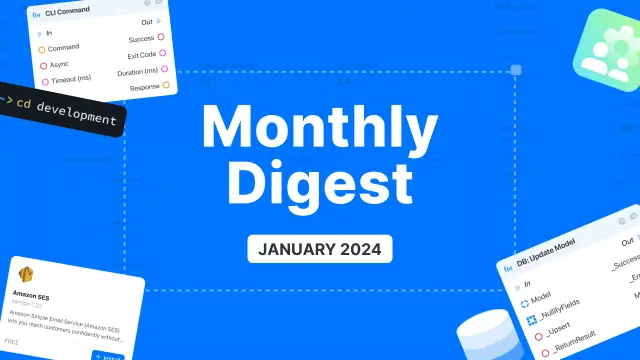
The January updates for our no-code platform are here! Discover new features that make creating apps on AppMaster faster and simpler than ever.
In January, we added the new BP Block: CLI Command. This feature enables you to execute operating system commands, which significantly expands the functionalities of applications and provides them with a broader range of capabilities.
Currently, it supports commands for Linux and Bash, with the potential for expansion in future updates to accommodate more operating systems. Although this feature isn't available for cloud-hosted applications for security reasons, developers with on-premise deployments can now enjoy the benefits of integrating CLI commands directly into their app workflows, opening up a host of new functional possibilities.
Another noteworthy improvement is the new Amazon SES module that leverages AWS Simple Email Services. This feature offers a cost-effective solution, with prices starting as low as $0.10 per 1000 emails, which is particularly beneficial for businesses seeking to maintain a budget-friendly communication strategy.
While activating this module requires some initial setup, the affordability and reliability of using AWS SES through AppMaster can significantly enhance your app's email capabilities.
To further enhance the functionality of Business Processes (BP), we have improved the DB Update block with Upsert support. This feature smartly updates only the fields where new values have been provided, streamlining the database update process and ensuring efficiency. This shift signifies our commitment to continual improvement and adopting more advanced data handling techniques in our no-code platform.
This month, we also rolled out a notable update for our authentication module to enhance the security of user sessions. Developers can now select a specific set of tokens for session storage.
We’ve also added an HTTP-Only Cookie into the system. Now, you can use secure HTTP-Only Cookies alongside Bearer tokens to reduce the chance of someone stealing session information from Local Storage.
Moreover, for developers using Postman, this update means cookies are saved automatically for easier subsequent requests. You need to activate this feature explicitly in the module settings since it's turned off by default.
With every update, we're making AppMaster better and easier for you to use, helping turn your great ideas into real, working apps. Dive in and see how these latest improvements can help you build the app you've been thinking about. We're excited to see what you'll create!
 What is new in the January AppMaster update?
The January release adds a CLI Command business-process block, an Amazon SES email module, smarter database upserts, and session-storage options in the authentication module.
What can the new CLI Command block do?It lets an on-premise AppMaster application run Linux and Bash commands from a business process. You can connect application workflows to operating-system tasks when your deployment environment allows it.
Can I use CLI Command in AppMaster Cloud?No. AppMaster does not allow the CLI Command block in cloud-hosted applications because running operating-system commands creates security risks. Use it with an on-premise deployment instead.
Which systems does CLI Command support?The block currently supports Linux and Bash commands. AppMaster may add support for other operating systems in later releases, but this update only describes Linux and Bash.
What is the Amazon SES module for?The Amazon SES module connects your app to AWS Simple Email Service, so you can send email through AWS from AppMaster. It suits apps that need transactional or operational email without building the connection yourself.
How much does email through Amazon SES cost?AWS SES pricing can start at about $0.10 per 1,000 emails, though your actual AWS bill depends on your account and use. You still need to complete the initial AWS and module setup before sending mail.
How does the improved DB Update block work?Upsert updates an existing database record when it finds one, or creates a record when it does not. The improved block updates only fields that receive new values, which helps prevent unwanted changes to other data.
What changed in the authentication module?You can choose which tokens AppMaster stores for a user session. This gives you more control over how your application handles authentication data.
Why use HTTP-Only cookies for sessions?An HTTP-Only cookie keeps session data out of browser Local Storage, which can reduce exposure to some script-based attacks. You can use it alongside Bearer tokens when that setup fits your app.
Do I need to enable the new cookie setting?No. The cookie option starts turned off, so you must enable it in the authentication module settings. Once enabled, Postman can save the cookies automatically for later requests.
Experiment with AppMaster with free plan.
When you will be ready you can choose the proper subscription.
 Jul 14, 20268 min
 Jul 13, 20268 min
 Jul 08, 20268 min