


 Jul 14, 2026
 8 min
8 minEquipment reservation app: prevent conflicts and track returns
Plan an equipment reservation app that prevents double bookings, records returns and damage, and places faulty items on maintenance hold.

Unveil the latest AppMaster upgrades and features!
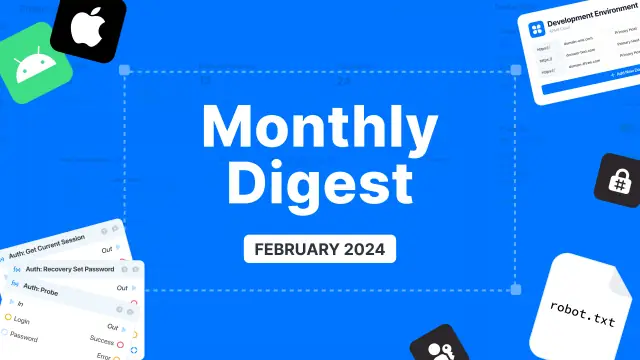
Every month, we work to improve AppMaster, and this February, we've packed it with new features to make app creation even easier and more secure.
Let's explore what's new and how it can transform your app-building process!
You can now assign multiple custom domains within a single deployment plan. This enhancement allows for seamless configuration of various web or backend applications to operate under different domains.
Tailoring your project's digital footprint just got easier, as this functionality opens up new possibilities for organizing and differentiating the components of your app suite, giving each piece its own distinct domain space.
We're also excited to announce a significant update to the Auth module for generated backend applications on AppMaster. Here are the key improvements:
These updates enrich the Auth module, providing you with a more secure, efficient, and modern backend authentication system.
With the latest updates, we've introduced new capabilities for managing essential files that play a pivotal role in your app's deployment strategy.
You can now directly configure files such as `robots.txt`, `assetlinks.json`, and `apple-app-site-association` within your deployment plan. These configurations are particularly crucial for those looking to implement deep linking strategies, as the `assetlinks.json` and `apple-app-site-association` files are key to setting up deep links that allow users to navigate to specific areas within your mobile application.
This nuanced control over important web and app files furthers our commitment to providing a comprehensive no-code platform that addresses the intricate details of app deployment and user engagement.
In February, we also introduced some new features for iOS developers to enhance their app-building experience.
These updates enrich the iOS development experience for our users and pave the way for more dynamic and interactive app creations.
We’re also thrilled to introduce several new features for Android development, enabling the creation of more sophisticated and secure applications:
With each enhancement, we're making AppMaster even more user-friendly and secure, so you can effortlessly turn your ideas into fully functional apps. Stay tuned for further updates!
 Can one AppMaster deployment use multiple custom domains?
A single deployment plan can now use several custom domains. You can place different web apps or backend services under separate domains while keeping them in the same plan.
Why would I assign different domains to one project?Use separate domains when your project has distinct public areas, such as a customer portal, an admin app, and an API. This keeps each part easy to identify and configure.
What new authentication flows can I build?The updated Auth module adds visual blocks for registration, sign-in, password reset, password recovery, credential checks, and session handling. You can build these flows in the Business Process Editor.
What does the Probe block do?The Probe block checks a user's credentials without creating a session. Use it when you need to verify a password before deciding whether to sign the user in.
How is Get Current Session different from Get Current User?Get Current Session gives your backend access to details about the active session, while Get Current User focuses on the signed-in user. Choose the session block when your logic needs session-level control.
Does AppMaster support passkeys?AppMaster now includes blocks for Passkey, which uses the FIDO2 standard. Passkeys can give users a secure sign-in option without relying only on passwords.
Which deployment files can I configure?You can configure robots.txt, assetlinks.json, and apple-app-site-association directly in a deployment plan. This lets you manage files that affect search crawling and mobile app links alongside your deployment settings.
How do I set up mobile deep links?Configure assetlinks.json for Android and apple-app-site-association for iOS. These files connect your domain to the mobile app so supported links can open the right screen in the app.
What is new for iOS apps?iOS apps can now use Geo types, Unicode tools, image compression and editing blocks, and Stripe payments. These additions help you handle locations, text, images, and payments in visual logic.
What are the main Android updates?Android now supports Geo types, model-field updates, many math and cryptography blocks, and Versioned, Server-Driven, and Static generation modes. Pick the mode that fits how you plan to deliver and update your app.
Experiment with AppMaster with free plan.
When you will be ready you can choose the proper subscription.
 Jul 14, 20268 min
 Jul 13, 20268 min
 Jul 08, 20268 min