


 Jul 14, 2026
 8 min
8 minEquipment reservation app: prevent conflicts and track returns
Plan an equipment reservation app that prevents double bookings, records returns and damage, and places faulty items on maintenance hold.

Learn how to create and manage APIs effectively in 2024.

APIs, or Application Programming Interfaces, are a set of rules and protocols that enable different software applications to communicate and share data with each other. Essentially, APIs act as a contract between the service provider and the consumer, allowing a seamless exchange of information and facilitating interaction between different components of an application or between entirely separate applications.
APIs play a crucial role in modern software development as they provide numerous benefits:
Considering the numerous benefits and the increasing reliance on APIs in modern software architecture, understanding APIs and their proper implementation is crucial for developers and businesses alike.
APIs come in various types, each with its own set of advantages, limitations, and use cases. Here, we'll discuss some of the widely-adopted API types: REST, GraphQL, and SOAP.
REST is an architectural style for designing networked applications by utilizing HTTP and the principles of stateless communication. REST APIs are widely adopted due to their simplicity, readability, and compatibility with web technologies. They follow a predictable structure, making them easy to use and understand. Key benefits of REST APIs include:
GraphQL is a query language and runtime for APIs, developed by Facebook to address some limitations of REST APIs. Unlike REST, which uses a predefined set of endpoints and response formats, GraphQL allows the client to request only the specific data it needs, reducing over-fetching and under-fetching issues. Key benefits of GraphQL include:
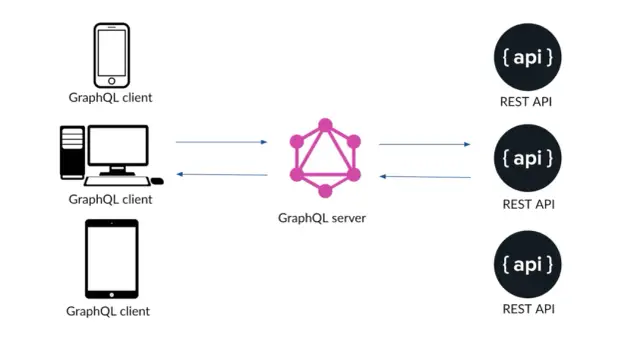
Image source: DEV Community
SOAP is an XML-based protocol for exchanging structured information between systems over HTTP. It offers several features geared towards enterprise applications and has been commonly used in scenarios that require strong security and transactional support. Key benefits of SOAP include:
Beyond these widely-adopted API types, there are also proprietary APIs tailored to specific products or platforms. Many companies build proprietary APIs to expose functionality of their products, allowing customers and developers to integrate with their systems seamlessly.
Microservices architecture has gained popularity in recent years, enabling developers to build applications as a collection of small, independently deployable services. APIs play a crucial role in this approach, as they provide a means for these different services to communicate and interact with one another.
Within the context of microservices, APIs perform the following key functions:
Using APIs in microservices architecture provides additional benefits, such as improved scalability, flexibility, and faster development cycles. By choosing the right API types and adhering to best practices, businesses can effectively leverage microservices architecture to achieve their software development goals.
APIs are essential for modern software architecture, and a streamlined approach to their integration can make all the difference in application development. AppMaster.io, a powerful no-code platform, offers an intuitive way to create and manage APIs for backend, web, and mobile applications with minimal coding expertise required.
Using AppMaster's drag-and-drop visual tools, you can easily design and test APIs, ensuring the entire development process is efficient and seamless. This platform allows you to develop more rapidly, making it up to 10 times faster and 3 times more cost-effective than traditional development methods. Furthermore, it eliminates technical debt by regenerating applications from scratch whenever requirements are modified. Here's how the platform assists with API integration:
The process of designing APIs with AppMaster involves a graphical user interface, making it easy even for non-programmers. You can visually create your API's data models, business logic, and endpoints by drag-and-drop components. This process speeds up the chunk of your development time and reduces the margin for human error, leading to better results.
AppMaster.io provides a complete API management solution, automating tasks like versioning, documentation, and monitoring. By automatically generating Swagger (OpenAPI) documentation and database schema migration scripts, AppMaster ensures the APIs are well-organized and easy to use by other developers or third-party services. Such a streamlined management process is essential for maintaining the quality and performance of your APIs throughout their lifecycle.
API security is not an afterthought with AppMaster's no-code platform. The platform handles essential aspects like authentication, authorization, and input validation. As a result, you can be confident that your APIs are following the best security practices, minimizing any chances of potential vulnerabilities or breaches.
With AppMaster, integrating third-party services becomes a breeze, regardless of whether you're working with a RESTful API, GraphQL, SOAP, or a proprietary API. The platform supports various industry-standard formats and protocols, allowing you to easily connect your application to popular services and data sources, all while maintaining consistency in your architecture.
Whenever you work with AppMaster.io, you are creating a blueprint and building a real application. After designing your APIs and application components, AppMaster generates source code, compiles, tests, packs, and deploys it to the cloud. The generated backend applications use Go (Golang), while web applications are built with Vue3 framework and JS/TS, and mobile applications use AppMaster's server-driven framework based on Kotlin and Jetpack Compose for Android and SwiftUI for iOS.
Not only does this approach improve scalability, but it also offers an unparalleled level of customization. You retain control over the generated binary files, source code (with an Enterprise subscription), and on-premises hosting capabilities.
AppMaster offers several subscription plans to cater to various requirements and budgets. From the free Learn & Explore plan to the comprehensive Enterprise plan, you can choose the option that best aligns with your objectives and resources.
APIs play a crucial role in any modern software architecture. The capability to create, manage and integrate APIs with a platform like AppMaster.io can save time, reduce costs, and minimize technical complexity. By adopting a no-code approach, you can unleash the full potential of APIs and harness their power to build reliable and scalable applications for the future of software development.
 What are APIs?
APIs (Application Programming Interfaces) are a set of rules and protocols that allow different software applications to communicate and share data with each other. They act as a contract between the service provider and the consumer, allowing seamless exchange of information.
What are the main types of APIs?The main types of APIs include REST (Representational State Transfer), GraphQL, SOAP (Simple Object Access Protocol), and proprietary APIs. Each type has its own set of advantages, limitations, and use cases, so businesses must choose the appropriate API for their needs.
How do APIs work in microservices architecture?In microservices architecture, APIs are used to enable communication between different services, allowing them to work independently of one another while still maintaining a cohesive application. APIs allow microservices to expose their functionality and data as an interface, making it easier for other services to interact with them.
What are some best practices for API design and management?Some best practices for API design and management include following industry standards, designing with the right architectural style, comprehensive documentation, embracing versioning, providing consistent error handling, and considering security from the beginning of the development process.
What security considerations should you take into account when working with APIs?When working with APIs, security considerations include authentication (verifying the identity of API consumers), authorization (ensuring users have the necessary permissions to access specific resources), input validation (guarding against malicious or malformed input), and proper error handling to prevent information leaks.
How can AppMaster's no-code platform help with API integration?AppMaster.io's no-code platform allows users to visually create and manage APIs for their applications, streamlining the process and enabling faster application development. With AppMaster, you can easily design and test APIs, ensure security best practices, and integrate with third-party services without the need for extensive coding expertise.
Experiment with AppMaster with free plan.
When you will be ready you can choose the proper subscription.
 Jul 14, 20268 min
 Jul 13, 20268 min
 Jul 08, 20268 min