


 Jul 14, 2026
 8 min
8 minEquipment reservation app: prevent conflicts and track returns
Plan an equipment reservation app that prevents double bookings, records returns and damage, and places faulty items on maintenance hold.

Discover the beginning and the probable future of No-Code.
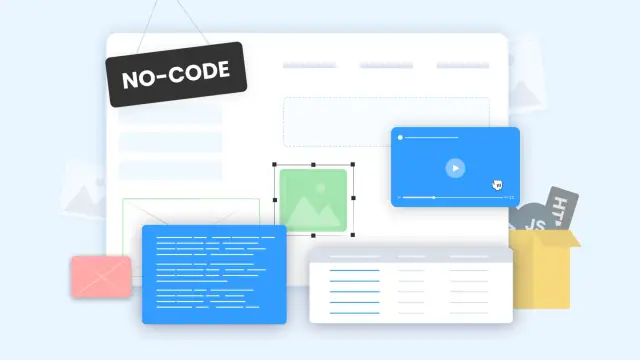
No-code development is a technique that allows users to create programs without writing any line of code. It is a form of visual programming based on the drag & drop visual builder.
The phenomenon of no-code, which just recently has become trendy, actually began its development back in the 90s. The first innovative no-code tools were the Dreamweaver, which is still produced by Adobe, and Frontpage, which was once part of Microsoft Office applications. Both platforms were created as Html editors, even though working with them required programming knowledge, some of the steps were automated.
Today, the possibilities of no-code platforms have significantly increased. With the growing demand, there is a wide range of platforms for creating programs, websites, and systems. This growth is due to many common problems that code-free development solves.
First, no-code platforms solve the problem of programmer shortage in the market and a limited supply of skills. Development without code allows people from different areas to create programs with an idea to start a business or improve the existing processes without involving programmers.
Secondly, no-code is fast. Developing by drag & drop of visual elements takes much less time than writing complete code.
Thirdly, programmers will have much more time to work with complex and truly interesting projects if no-code platforms replace them in the execution of routine processes.
No-code platforms are still not a universal tool and cannot completely replace developers. However, in the future, there will be a much greater amount of platforms with more features that will become the norm for daily use.
Appmaster.io is one of the new no-code platforms. The core idea of its creation was multifunctionality so that applications developed on the platform were not limited in capabilities. Therefore, Appmaster.io lets users work with the frontend and backend, create business processes, integrate the application with other services, and change the appearance of the application by the use of a visual designer. The platform itself will generate the source code for the final application, which will make it independent and indistinguishable from traditionally created applications.
Explore all abilities of no-code and create your app on Appmaster.io.
 What is no-code development?
No-code development lets people build software through visual tools instead of writing code by hand. You arrange screens, data, and logic in a builder, then the platform creates the application.
How do no-code platforms work?No-code platforms use visual editors, drag-and-drop components, and ready-made integrations. You define how the app should work, and the platform generates the technical parts behind it.
Is no-code a new idea?No. Early HTML editors in the 1990s, such as Dreamweaver and FrontPage, automated parts of web creation. Modern no-code platforms extend that idea to databases, business logic, APIs, web apps, and mobile apps.
What can I build with no-code?No-code helps teams build internal tools, customer portals, admin panels, sales tools, support systems, and process automation. It works best when a team needs a working application without starting every technical part from scratch.
Do I need coding skills to use no-code?Usually, you do not need programming skills to start. You still need to understand the process you want to improve, the data your app needs, and what each user should be allowed to do.
Why is no-code faster than traditional development?Visual building often shortens development because you configure existing components instead of coding each feature. The actual speed depends on the app's rules, integrations, and review process.
Will no-code replace software developers?No-code can take routine application work off developers' plates, but it does not replace them for every project. Developers still handle unusual requirements, deep technical work, architecture choices, and complex integrations.
What does AppMaster let me create?AppMaster lets you design database models, business processes, APIs, web interfaces, and native mobile interfaces visually. It generates source code for backend, web, and mobile applications rather than producing only a simple website.
Can I deploy or export an AppMaster application?AppMaster generates backend code in Go, web application code in Vue3, and native mobile code for iOS and Android with Kotlin and SwiftUI. You can deploy to AppMaster Cloud or supported cloud providers, or export source code for self-hosting.
How should I start my first no-code project?Start with one clear process, such as handling support requests or tracking sales leads. Map the users, screens, data, and steps first, then create the application in a no-code platform and test it with the people who will use it.
Experiment with AppMaster with free plan.
When you will be ready you can choose the proper subscription.
 Jul 14, 20268 min
 Jul 13, 20268 min
 Jul 08, 20268 min