


 Jul 14, 2026
 8 min
8 minEquipment reservation app: prevent conflicts and track returns
Plan an equipment reservation app that prevents double bookings, records returns and damage, and places faulty items on maintenance hold.

Unlock the true potential of your startup by exploring best practices in rapid app development, including strategies, technologies, and success stories of using no-code platforms like AppMaster.io.

Startups often face a unique set of challenges when it comes to app development. These challenges can vary depending on factors such as the stage of the startup, available resources, and the market segment in which it operates. Nevertheless, some common challenges faced by startups in app development include:
Rapid App Development (RAD) is an approach to software development that enables organizations, including startups, to build high-quality applications quickly using iterative development, reusable components, and visual tools. By reducing the complexity and streamlining the development process, RAD helps address many of the unique challenges faced by startups in app development. Here’s why startups need RAD:
Implementing Rapid App Development can provide startups with numerous benefits that can help them stand out from their competition and achieve long-term success. Some of the most significant benefits of RAD for startups include:

By embracing Rapid App Development principles and leveraging the right technologies and platforms, startups can overcome many of the challenges they face in app development, driving their success in the competitive tech industry.
As a startup, the right selection of tools and technologies will accelerate your rapid app development process and minimize potential roadblocks in achieving your goals. Various tools and technologies are available to aid in RAD depending on the skills of your team and the requirements of your project. Here are some of the most popular choices that startups can consider:
Low-code platforms offer visual tools for building web and mobile applications with minimal coding required. They are an excellent option for businesses needing increased customization and control while still enjoying the benefits of a streamlined development process. Examples of popular low-code platforms include OutSystems and Mendix.
No-code platforms enable users to create fully functional applications without writing any code. They are ideal for startups with limited technical skills and smaller budgets, as they allow non-technical founders and team members to build and iterate quickly. Examples of popular no-code platforms include Bubble, Wix, and AppMaster.io.
Application frameworks provide libraries and tools for building applications more rapidly than traditional programming languages and development environments. These frameworks support a variety of programming languages and platforms, such as React, Angular, and Flutter. While offering increased flexibility, they typically require more advanced coding skills compared to low-code or no-code solutions.
API and integration tools streamline the process of connecting different applications and services, allowing startups to focus on building their core functionality. Examples of popular API and integration tools include Zapier, IFTTT, and Postman.
No-code platforms are revolutionizing the software development process by empowering users to create fully functional applications without the need for advanced programming knowledge. Startups can leverage no-code platforms to accelerate their growth by implementing the following strategies:
With no-code platforms, non-technical team members can contribute to the application development process, enabling faster innovation and reduced reliance on specialized developers. Collaborative platforms help bridge the knowledge gap between technical and non-technical stakeholders, driving better communication and alignment within the team.
No-code platforms let startups quickly iterate on their applications based on user feedback and market trends, resulting in continuous improvement and a better product fit. The ease of making changes without extensive coding allows startups to remain agile and pivot faster in response to evolving demands.
No-code platforms reduce the need for hiring specialized developers and managing large development teams, significantly lowering the overall software development cost. They also shorten the learning curve for new team members, making expansion more manageable and cost-effective.
No-code platforms come equipped with a wealth of pre-built components and templates that streamline the development process. These resources allow startups to build functional and visually appealing applications without building every aspect from scratch.
AppMaster.io is a powerful no-code platform specializing in backend, web, and mobile application development. The platform employs a visual development approach, empowering users to create data models, business logic, API endpoints, and intuitive user interfaces with minimal effort. Here are some reasons why AppMaster.io is the perfect solution for startups looking to leverage rapid app development:
AppMaster.io generates applications using Go for backend, Vue3 for web, and Kotlin and SwiftUI for mobile. The resulting applications are highly scalable and performant, making AppMaster.io an excellent choice for startups that require rapid growth without sacrificing performance.
With every change applied to your application's blueprints, AppMaster.io will generate and deploy a new version of your application from scratch, effectively eliminating any technical debt inherent in the development process. This approach makes scaling your application a breeze and enhances your startup's long-term sustainability.
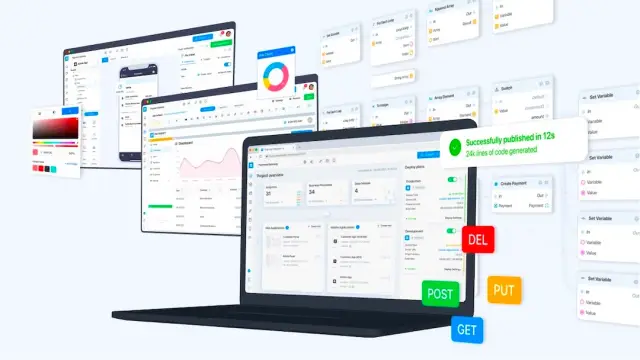
AppMaster.io supports integration with any PostgreSQL-compatible database as the primary database for your application. Additionally, the platform generates source code and binary files, allowing you to host the applications on-premises if required.
AppMaster.io offers various subscription plans to suit the needs of startups at different stages, from free plans for learning and testing to enterprise plans for large-scale projects. This flexibility ensures that your startup can access the platform's powerful features at a price point that fits your budget.
By leveraging no-code app development platforms like AppMaster.io, startups can accelerate their growth, streamline their development process, and build scalable, high-quality applications tailored to their specific needs. With ever-evolving tools and technologies available for rapid app development, it's an exciting time for startups to embrace the benefits of RAD and propel their businesses to success.
 What is rapid app development (RAD)?
Rapid app development (RAD) is an approach to software development that focuses on quickly building high-quality applications using iterative development, reusable components, and visual tools to reduce complexity and streamline the development process.
How do startups benefit from rapid app development?Startups benefit from rapid app development by speeding up their time to market, reducing development costs, enabling faster pivots, and decreasing technical debt.
What are the key challenges startups face in app development?Startups often face challenges in app development such as limited resources, tight budgets, time constraints, keeping up with industry trends, and the need to pivot quickly in response to market changes.
Why should startups consider no-code app development platforms?Utilizing no-code app development platforms allows startups to build applications quickly and cost-effectively without requiring extensive coding skills, empowering non-technical founders and team members to contribute to the development process and promoting rapid innovation.
What is the role of AppMaster.io in rapid app development for startups?AppMaster.io is a leading no-code platform that enables startups to create backend, web, and mobile applications quickly and efficiently while eliminating technical debt, streamlining the development process, and providing a scalable solution that supports the growth and success of startups.
How can startups leverage AppMaster.io for rapid app development?Startups can use AppMaster.io's visual tools to create data models, business logic, API endpoints, and interactive user interfaces, and then generate and deploy applications with the click of a button, significantly speeding up the development process and reducing the need for in-house development resources.
What are some real-life success stories of startups using rapid app development?There are several success stories of startups that have used rapid app development to accelerate their growth, including companies that have improved their time to market, cut development costs, and scaled up their operations quickly by leveraging the power of no-code platforms like AppMaster.io.
What strategies can startups adopt to maximize the value of rapid app development?Startups can maximize the value of rapid app development by selecting the right tools and technologies, encouraging cross-functional collaboration, investing in platform training, iterating quickly based on user feedback, and embracing a culture of continuous improvement.
Experiment with AppMaster with free plan.
When you will be ready you can choose the proper subscription.
 Jul 14, 20268 min
 Jul 13, 20268 min
 Jul 08, 20268 min