


 Jul 14, 2026
 8 min
8 minEquipment reservation app: prevent conflicts and track returns
Plan an equipment reservation app that prevents double bookings, records returns and damage, and places faulty items on maintenance hold.

Discover the impact of low-code platforms on traditional software development processes and how it is shaping the future of custom application creation.

The digital transformation wave has had a massive impact on businesses worldwide. As a result, the demand for custom software solutions has skyrocketed, and companies are struggling to keep up with the need for faster and more efficient development processes. This increasing demand has given birth to the rise of low-code platforms.
Low-code development platforms have emerged as revolutionary tools in modern software development. These platforms offer a more straightforward way to develop applications by relying on visual interfaces and pre-built components, minimizing the need for manual coding. They enable developers and non-developers alike to build comprehensive applications without extensive coding expertise or time-consuming development cycles. This innovative approach to software development is helping businesses keep up with the ever-evolving digital world.
By breaking down barriers and democratizing the development process, low-code platforms are enabling companies to deliver applications more rapidly, adapt to changing requirements, and provide value to their customers faster than ever before.
Low-code platforms come with a wide range of features that simplify and expedite the development process. Some of the key features of low-code solutions include:
Low-code platforms are transforming how businesses develop and deploy applications by bringing a plethora of benefits to the table. Some of the most significant advantages of embracing low-code solutions are:
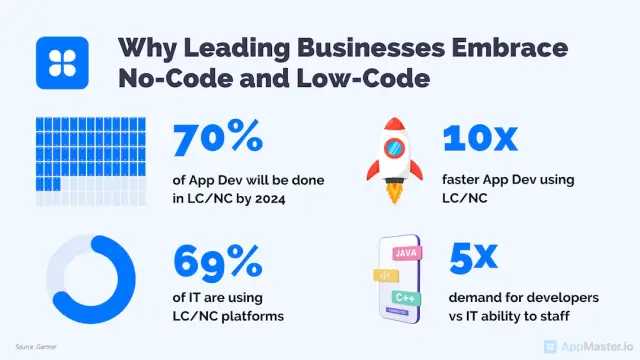
Low-code development is changing the industry, offering businesses a more practical and efficient way to develop custom software applications. With advantages like faster deployment, lower costs, and increased flexibility, low-code platforms are poised to play a significant role in the future of software development. Companies like AppMaster are at the forefront of this revolution, offering powerful no-code solutions that make application development more accessible, efficient, and cost-effective for businesses of all sizes.
While low-code platforms have undoubtedly revolutionized software development, they are not without their share of challenges and limitations. To make an informed decision about adopting low-code, it is crucial to understand the potential drawbacks and limitations it may present.
Low-code platforms automate much of the coding and optimization, which can sometimes result in less efficient code. This can lead to diminished performance in some cases, particularly in highly complex or resource-intensive applications.
While low-code platforms have enabled users to create various applications with ease, they may not provide the level of customization that some businesses require. For highly specialized or unique use cases, low-code platforms may impose constraints that can hinder the desired outcome.
When adopting a low-code platform, you become reliant on the vendor to maintain, support, and evolve the platform. If the vendor ceases support or discontinues the product, it may leave your applications in a precarious state. It is essential to choose a reliable vendor and stay informed about upcoming product changes.
As with any platform, low-code solutions come with inherent risks and potential vulnerabilities. It is vital to evaluate the security measures implemented by the platform and ensure they align with your company's security requirements. Likewise, in some low-code platforms, you may have limited control over the underlying infrastructure, which could impact your ability to fully customize and secure your applications.
The adoption of low-code platforms has had a significant impact on the roles and responsibilities of development teams. As low-code empowers non-developers to create applications, it is changing the dynamics of traditional software development teams, leading to a more collaborative and efficient environment.
Low-code platforms enable non-developers, often referred to as citizen developers, to actively participate in the application development process. This democratization of app development allows subject matter experts to create solutions tailored to their unique needs, significantly expanding the application project's knowledge base.
As citizen developers handle more straightforward development tasks, skilled developers can focus their energies on more complex and innovative activities. By shifting their focus to more high-value work, developers can push the boundaries of what can be achieved in software development, ultimately driving better outcomes for the business.
Low-code platforms foster better communication and collaboration between developers and non-developers. With a common development environment, team members can easily understand each other's work, provide valuable insights, and collectively drive innovation. This collaborative approach allows organizations to develop software faster and achieve better results.
The rise of low-code platforms has led to more opportunities for non-developers to expand their skillsets. As they begin to create applications, they get a better understanding of the technical aspects of development, ultimately making them more well-rounded professionals. This knowledge can be invaluable as they continue to work alongside developers to create and maintain applications.
AppMaster is a comprehensive no-code platform, allowing users to develop backend, web, and mobile applications visually, without the need for extensive coding expertise. With its powerful capabilities, AppMaster is revolutionizing the software development process by making it more efficient, cost-effective, and accessible to a broader range of users. AppMaster's features include:
AppMaster users can visually create data models (database schema) and business logic (business processes) via their unique BP Designer. This enables users to construct complex applications without writing extensive code.
The platform offers a drag-and-drop UI Builder for web and mobile applications, empowering users to create interactive user interfaces easily. AppMaster applications are generated with popular frameworks, such as Vue3 (web apps), Kotlin and Jetpack Compose (Android), and SwiftUI (iOS).
AppMaster allows users to deploy applications to the cloud with a single press of the 'Publish' button. By automatically generating and managing source code, compilation, testing, and packaging, AppMaster streamlines the deployment process and ensures applications are kept up-to-date.
AppMaster applications are compatible with any Postgresql-based primary database and offer amazing scalability due to their compiled, stateless backend architecture.
One of AppMaster's key selling points is its ability to eliminate technical debt. The platform regenerates applications from scratch whenever requirements are modified, ensuring a clean, up-to-date codebase. This, in turn, saves organizations time and resources that would otherwise be spent on maintaining and resolving legacy code issues.
As a high-performing, top-rated no-code development platform, AppMaster is a powerful solution for organizations looking to embrace the low-code/no-code revolution and streamline their software development processes. Combined with its ability to eliminate technical debt, AppMaster helps businesses innovate more quickly and efficiently than ever before.
Low-code development platforms are transforming the tech industry, making software development more accessible, efficient, and collaborative. The future of software development with low-code is likely to involve greater innovation, more streamlined processes, and a shift in traditional development roles. Here, we explore some of the trends and developments that may define the future of software development with low-code.
As businesses continue to recognize the advantages of low-code development, the demand for these platforms is expected to grow. According to Gartner, by 2025, more than half of all medium-to-large enterprises will have adopted low-code as their primary method of application development. This increased adoption will drive better tools and platforms, leading to more sophisticated solutions becoming available for a wider range of use cases.
Low-code platforms empower citizen developers, allowing them to create custom applications without extensive coding skills. This leads to the democratization of software development, empowering non-developers to take a more active role in building applications. This trend is expected to continue, making software development more accessible to a diverse group of professionals and driving innovation in various industries.
Low-code platforms enable better collaboration between developers and non-developers by promoting a shared understanding of the development process. The future of software development is likely to see increased coordination between development teams and other departments within an organization. This would lead to better communication and understanding, resulting in more effective and efficient application development.
The integration of artificial intelligence (AI) and machine learning in low-code platforms will further streamline the development process. AI-driven assistance can help automate repetitive tasks, recommend best practices and guidelines, and improve overall code quality. With AI and machine learning technologies becoming increasingly accessible, it is expected that they will play a more significant role in the future of low-code development.
The future of low-code software development will likely include more seamless integration with other tools, technologies, and platforms. This would enable businesses to create cohesive solutions that leverage various components for enhanced functionality and performance. Greater interoperability will also simplify the process of connecting low-code applications with existing systems and infrastructure, reducing the need for complex integration work.
With the growing popularity of low-code development, security and compliance concerns will become even more important. Platforms need to ensure that applications built using low-code tools are secure, data protection standards are maintained, and the solutions comply with relevant regulatory requirements. Future developments in low-code platforms are likely to focus on enhancing security and compliance features to build trust among users.
All in all, the ongoing advances in low-code technologies are reshaping the software development industry. They are making it more inclusive, efficient, and collaborative, driving innovation at an unparalleled pace. Low-code and no-code platforms, like AppMaster, will continue to evolve and improve, further disrupting traditional software development and unlocking new possibilities for businesses across the globe.
 What is low-code development?
Low-code development is an approach to software development that enables users to create applications through visual interfaces and minimal manual coding. This significantly reduces the complexity and time needed to develop applications.
How do low-code platforms benefit businesses?Low-code platforms can help businesses by reducing development time, lowering costs, increasing flexibility, and enabling faster innovation. They also make it easier for non-developers to participate in the development process and create custom solutions for their needs.
Are there any limitations or challenges in using low-code platforms?While low-code platforms offer many benefits, they can come with limitations such as potential performance issues, lack of flexibility for highly specialized use cases, and reliance on the platform vendor. It is essential to evaluate the suitability of a low-code platform for your specific needs.
How do low-code solutions affect traditional software development roles?Low-code platforms change traditional development roles by enabling non-developers to create applications and empowering developers to focus on more complex tasks, problem-solving, and innovation. This shift can lead to more well-rounded, collaborative teams.
What is AppMaster?AppMaster is a powerful no-code platform that allows users to create backend, web, and mobile applications visually, without extensive coding skills. AppMaster makes application development faster, more cost-effective, and helps eliminate technical debt.
How can low-code platforms improve collaboration between developers and non-developers?Low-code platforms bridge the gap between developers and non-developers by enabling the latter to participate actively in the development process. This fosters better communication, understanding, and collaboration among team members working on an application project.
How does low-code help reduce technical debt?Low-code and no-code platforms, like AppMaster, reduce technical debt by regenerating applications from scratch whenever requirements are modified, ensuring a clean and up-to-date codebase. This saves time and resources spent on maintaining legacy code and addressing technical debt issues.
What does the future of software development look like with low-code?The future of software development with low-code is expected to be more efficient, collaborative, and accessible to a wider range of professionals. It is likely to continue evolving, providing businesses with more streamlined processes for creating custom applications and driving innovation at a faster pace.
Experiment with AppMaster with free plan.
When you will be ready you can choose the proper subscription.
 Jul 14, 20268 min
 Jul 13, 20268 min
 Jul 08, 20268 min