


 Jul 14, 2026
 8 min
8 minEquipment reservation app: prevent conflicts and track returns
Plan an equipment reservation app that prevents double bookings, records returns and damage, and places faulty items on maintenance hold.

Explore the influence of REST (Representational State Transfer) on modern software architecture, its principles, evolution, and the benefits it brings to applications and APIs.

REST (Representational State Transfer) is an architectural style introduced by Roy Fielding in his 2000 PhD dissertation. The primary focus of REST is to provide a set of constraints and principles to make web services scalable, maintainable, and simple. REST has been widely adopted in modern software architecture, shaping how applications communicate through the internet.
The core idea behind REST is the effective use of resources. In the context of web services, resources can represent anything from images, documents, or objects. The resources are identified by an HTTP Uniform Resource Identifier (URI) and manipulated using standard HTTP methods, such as GET, POST, PUT, and DELETE. This approach ensures the simplicity and predictability of communication between client and server systems while respecting the fundamental principles of the web.
The primary principles that guide RESTful architectures are:
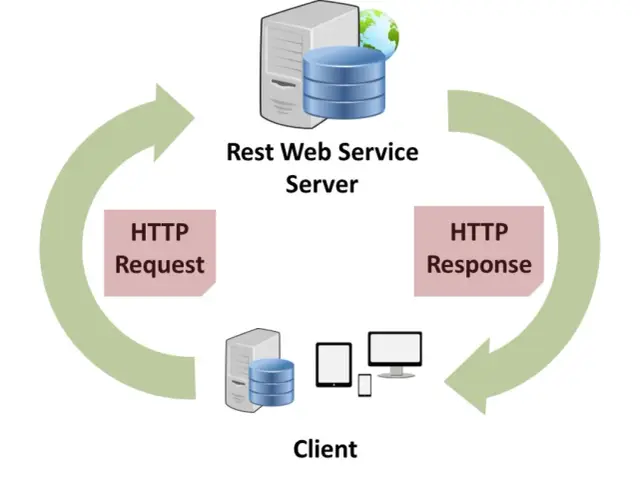
Image source: restfulapi.net
Adhering to these principles ensures that RESTful software architectures exhibit the traits of scalability, simplicity, and maintainability demanded by modern web services.
Before the widespread adoption of REST, many web services followed the SOAP (Simple Object Access Protocol) standard or used custom and proprietary communication protocols, often leading to inefficiencies and interoperability challenges. SOAP relied on XML-based message formats and complex procedures, while the custom approaches required clients and developers to learn and adapt to new systems.
With the introduction of REST, a more cohesive and standardized way of designing web services emerged. REST shifted the focus from complex message formats and procedural calls to resources and standardized HTTP methods. This approach eliminated the need for extensive documentation and additional tools to understand and interact with web services making the development and integration process easier, faster, and more scalable.
One of the most significant implications of the REST revolution is the evolution of APIs (Application Programming Interfaces). Modern APIs designed with RESTful principles provide an efficient way for developers to interact with data and services, enabling better software integration and reducing development time and effort. This has fueled the growth of various web technologies, microservices, and cloud computing, consequently improving the quality and efficiency of contemporary software projects.
The rise of REST in software architecture has prompted developers and organizations to adopt best practices and standards, enabling them to build scalable and maintainable applications that cater to the ever-evolving demands of the digital world.
REST has significantly impacted the way APIs are designed and implemented. Empowered by its principles, RESTful APIs have become a standard in modern web services, ensuring better scalability, reliability, and simplicity of communication. RESTful APIs leverage the existing HTTP and URI protocols, making creating universally compatible interfaces for various applications easier. They reduce the complexity of development, testing, and troubleshooting, as they utilize standardized methods for handling resources (such as GET, POST, PUT, PATCH, and DELETE), allowing developers to focus on the business logic and data models.
AppMaster is a powerful no-code platform that embraces these principles in providing its users an efficient way to design and manage their applications' backends, web, and mobile interfaces. By automatically generating RESTful API and WSS Endpoints, AppMaster simplifies how customers can create data models and business processes using its visual environment. These APIs act as an interface between the frontend and backend, making it easier to exchange data and execute tasks in a clearly defined manner.
Moreover, AppMaster ensures that the generated applications can work with any Postgresql-compatible primary database, making it a perfect choice for enterprise and high-load use-cases. Its seamless integration with RESTful principles thus contributes to a more scalable architecture that can grow and evolve with the customer's changing needs.
Adopting a RESTful architecture benefits modern applications and software development processes. These advantages can improve efficiency, better scalability, and easier integration with other systems and services.
RESTful architectures are inherently designed to scale. This is achieved through client-server separation and other principles maintaining a stateless communication environment. As the number of resources and clients grows, RESTful applications can handle such growth with minimal impact on their performance and reliability.
One of the key principles of REST is the cacheability of resources, contributing to improved application performance. By allowing clients to cache certain resources, you can reduce the number of requests made to the server and, in turn, minimize the load on your system.
Stateless communication in RESTful systems ensures better fault tolerance, as each request made to the server carries all the information needed to process it. This, combined with the layered system architecture, increases reliability and maintainability.
RESTful architectures are designed to be flexible and extensible. This lets developers easily add and modify new features without disrupting the entire system. This flexibility makes it simpler to evolve applications over time in response to changing business requirements.
Using standardized HTTP methods and well-defined resource naming conventions, RESTful APIs simplify the application's resource management. Developers can focus on building the core functionality instead of worrying about implementing custom communication protocols.
RESTful APIs can be easily integrated with various systems and services due to their compatibility with existing web standards. This offers increased flexibility and the ability to leverage third-party solutions to further enhance the application's capabilities.
REST has played an essential role in shaping modern software architecture, and its influence is expected to continue as APIs and web-based services remain crucial components in various applications. But the future of software design is bound to evolve with emerging technologies and architectural patterns, making it imperative for developers to stay informed and adaptable. For instance, new communication protocols and architectural styles like GraphQL, gRPC, and WebSocket are gaining popularity as alternatives to REST.
These technologies offer specific advantages in certain use-cases over REST, such as lower latency, real-time communication, and more flexible querying capabilities. As such, developers need to evaluate these options and choose the best-suited approach based on their specific application requirements.
Nevertheless, REST will likely remain a go-to architectural style for many scenarios, particularly when building web services and APIs requiring simple, standardized, and scalable communication methods. "Innovation is the calling card of the future," as wisely stated by Anna Eshoo. By keeping abreast of the latest architectural styles and technological advancements, developers can make well-informed decisions and maintain the competitive edge needed in today's software industry.
 What is REST?
REST (Representational State Transfer) is a software architectural style that defines a set of constraints and principles applied to modern web services. It focuses on the effective use of resources and standards to ensure their scalability, simplicity, and maintainability.
What are the key principles of REST?Stateless communication Cacheable resources Client-Server separation Uniform interface Layered system architecture Code-on-demand (optional)
How has REST impacted software architecture?REST introduced a more efficient way to design web services, focusing on resources and standardized HTTP methods. It led to the evolution of APIs, thus making the development and integration process easier, faster, and more scalable.
Why is REST popular in API design?REST is popular in API design because it leverages existing web standards like HTTP and URI, making it easier to implement, understand, and maintain. It also ensures better scalability, flexibility, and extensibility of APIs.
How does AppMaster incorporate REST?AppMaster, a powerful no-code platform, allows customers to create backend, web, and mobile applications that follow RESTful principles. AppMaster automatically generates REST API and WSS Endpoints and provides developers with an easy-to-use visual environment for designing business logic and data models.
What are the benefits of using RESTful architecture?Improved scalability Enhanced performance Increased reliability Extensibility and flexibility Simplified API and resource management Easy integration with other systems
Is REST suitable for all types of applications?REST is well-suited for web-based applications and APIs that rely on client-server communication and scalable architectures. However, it might not be the best choice for real-time applications or systems requiring low-latency communication, where alternative architectures like WebSocket or gRPC may be more appropriate.
What is the future of REST in software design?REST will likely continue to be a crucial aspect of software design, particularly for web services and APIs. However, as technology evolves and new architectural styles emerge, it's essential for developers to stay informed and adopt the best practices for their specific use-case.
Experiment with AppMaster with free plan.
When you will be ready you can choose the proper subscription.
 Jul 14, 20268 min
 Jul 13, 20268 min
 Jul 08, 20268 min