


 Jul 14, 2026
 8 min
8 minEquipment reservation app: prevent conflicts and track returns
Plan an equipment reservation app that prevents double bookings, records returns and damage, and places faulty items on maintenance hold.

Explore how low-code AI platforms are revolutionizing education by enabling educators to easily integrate advanced technology into the classroom, enhancing learning and teaching dynamics.

Integrating Artificial Intelligence (AI) in the educational sector is not an entirely new concept. Still, its widespread adoption has often been hampered by the steep learning curve and complexity of programming AI applications. However, the emergence of low-code and no-code development platforms has begun to reshape this narrative, offering an inclusive gateway to technological innovation in classrooms worldwide. These platforms have democratized access to AI by providing intuitive visual interfaces, which allow educators to create and customize powerful AI-driven applications without extensive coding expertise.
Low-code AI platforms empower teachers to foster a more engaging and personalized learning environment. By utilizing such platforms, educators can harness the power of machine learning, natural language processing, and data analytics to provide adaptive learning paths, automate administrative tasks, and gain insights into students' progress and educational needs — realizing a long-envisioned goal of delivering individual attention at scale.
The shift towards low-code AI in education aligns with broader macro-trends. As societies emphasize digital literacy and the education systems pivot to embrace 21st-century skills, low-code AI becomes a critical tool in the educator's kit. By simplifying the development process, these platforms enable teachers to spend less time grappling with the intricacies of programming and more time designing innovative solutions that address educational challenges and inspire students.
The pandemic has also accelerated technology adoption in education, highlighting the need for flexible and adaptive teaching tools. Low-code AI platforms have proven instrumental, facilitating rapid response to the dynamic demands of remote learning and blended classrooms. Furthermore, integrating AI-driven analytics and insights assists in the shift to competency-based education, allowing for tracking student mastery rather than simply measuring seat time.
Even in developing nations, low-code AI contributes to bridging the technological divide. With the ease of use and reduced costs associated with low-code solutions, schools with limited resources can now introduce advanced technological tools into their curricula. This democratizes high-quality education and drives global efforts towards inclusive and equitable quality education for all, as outlined in the United Nations Sustainable Development Goals.
The rise of low-code AI in education is pivotal. It not only facilitates the creation of innovative, adapted, and accessible teaching aids but also embodies a movement towards a future where educators are not just consumers of technology, but creators capable of shaping the digital tools that define the educational experiences of their students.
Adopting low-code AI in educational settings unleashes benefits catering to teachers and students, dramatically reshaping the conventional classroom dynamic. Innovative teaching tools and processes enabled by low-code AI platforms make education more interactive, personalized, and efficient.
Teachers stand to gain considerably from the integration of low-code AI. By utilizing these platforms, they can:
Students experience the direct advantages of low-code AI through a learning experience that is engaging, supportive, and responsive to their needs:

Incorporating low-code or no-code AI within the educational framework significantly enhances traditional methods and bridges to an advanced educational future. For instance, a platform like AppMaster can empower educators to build learning apps or administrative tools that leverage AI functionalities, providing an accessible path towards realizing these benefits.
Low-code AI is not just a futuristic concept — it's a present-day reality making significant strides in classrooms across the globe. These tools open up new possibilities for educators and students, providing real-world applications that augment the teaching and learning process. Let's explore some of these applications and how they transform the educational experience.
One of the standout applications of low-code AI in education is the development of personalized learning platforms. These systems analyze individual student performance and learning styles, then adjust curriculum content accordingly. For example, a platform might present more visual content to students who learn better through images or provide additional challenges to those who master topics quickly. This approach caters to students' diverse needs and allows for differentiation in instruction without increasing the workload for teachers.
Intelligent tutoring systems (ITS) are AI-driven applications that simulate one-on-one tutoring sessions. Teachers can leverage low-code platforms to design ITS solutions that provide instant feedback to students, walk them through problem-solving steps, and offer tailored help on particular subjects. These systems are particularly useful in large classes where individualized attention can be challenging to provide.
Grading assessments can be time-consuming, but low-code AI makes it easier with automated grading systems. These applications mark answers as correct or incorrect and provide insights into common mistakes and misconceptions, facilitating targeted follow-up instruction. This automation frees up valuable time for teachers to focus on lesson planning and student interaction.
Language learning is another area ripe for innovation with low-code AI applications. Tools created on these platforms can assist with pronunciation, grammar, and vocabulary acquisition through interactive exercises that adapt to the learner's proficiency level. Moreover, AI can be integrated to simulate conversation, allowing for practice in a safe, low-pressure environment.
Students often have questions about homework or upcoming exams outside of instructional time. Educators can utilize low-code AI to create chatbots that act as virtual teaching assistants, available to answer student inquiries at any hour. These AI systems can parse student questions to provide relevant information or guide students through complex topics, ensuring support is always at hand.
Subjects that involve complex systems or phenomena, such as chemistry and biology, can greatly benefit from interactive simulations and virtual labs. Low-code AI platforms enable teachers to craft dynamic models that students can manipulate, facilitating experiential learning. These simulations can demonstrate theories that would be difficult, expensive, or even dangerous to replicate in a physical classroom setting.
To gauge the effectiveness of teaching strategies, behavioral analytics can be integrated into classroom activities. Low-code AI tools can be fashioned to track engagement metrics, such as participation rates and attention spans, and interpret this data to improve lesson plans. This proactive adjustment to teaching methods can lead to better educational outcomes.
Ensuring that learning materials are accessible to all students, including those with disabilities, is a key priority in education. Low-code AI applications can be structured to provide assistive technologies, such as text-to-speech for visually impaired students or gesture recognition systems for those who communicate using sign language. These applications make education more inclusive and foster an environment where every student can thrive.
By providing tools that automate research data collection or analyze project outcomes, low-code AI can facilitate project-based learning (PBL), a teaching method where students learn by actively engaging in real-world and personally meaningful projects. This hands-on approach, enhanced by AI, can develop critical thinking, collaboration, and creative problem-solving skills.
Using low-code AI in educational settings is proving to be a game-changer, offering educators many ways to augment their teaching and engage students deeply with the subject matter. As technology advances, AI's potential to reshape the classroom will only grow, encouraging a more active, personalized, and inclusive learning environment.
Education is no exception as artificial intelligence becomes increasingly integral to various industries. The integration of AI within the educational sector has the potential to fundamentally reshape the way educators teach and students learn. A pivotal element in this transformation is the emergence of low-code AI platforms. These platforms serve as a bridge between complex AI technologies and the everyday tools used in classrooms. Let's delve deeper into what they offer and how they enable educators to leverage the power of AI.
Low-code AI platforms offer a simplified interface through which users with limited coding expertise can develop applications that utilize AI components. These interfaces often rely on graphical elements, like drag-and-drop builders, and pre-designed templates that can be customized to serve specific educational purposes. The approach is fundamentally inclusive, democratizing access to emerging technologies that were once the purview of specialists with a deep understanding of machine learning algorithms and data science.
Key features that make low-code AI platforms appealing for educational use include:
Under the hood, low-code AI platforms are powered by sophisticated algorithms and machine learning models that developers have refined into user-friendly components. This concealment of complexity allows educators to benefit from AI advancements without an in-depth understanding of the underlying technology. It also mitigates the need for extensive infrastructure usually required for AI applications, as the platforms come equipped with the necessary computational resources provided via the cloud.
The practical implications for educators are substantial. Tasks that were previously time-consuming, such as grading or personalizing lesson plans for varied learning speeds, can be automated or facilitated with AI. Furthermore, platforms offer analytics capabilities enabling educators to track progress, identify student challenges quickly, and modify teaching tactics accordingly. These platforms enhance efficiency and empower educators to offer richer, data-driven educational experiences.
Various providers cater to the education sector with low-code AI offerings, each bringing unique features. For instance, AppMaster offers an environment where educators can build and deploy AI-enabled applications rapidly without delving into the complexities of coding. Its no-code approach allows for creating both backend solutions and user-facing interfaces that are attuned to the educational environment's needs.
Low-code AI platforms are burgeoning tools that have far-reaching potential within education. They present an accessible path for educators to integrate advanced AI capabilities into their workflows, providing students with an enriched learning experience. These platforms are more than just a trend; they're shaping up to be cornerstones of future educational practices, bringing AI's transformative power into the reach of every teacher and student.
In educational technology, AppMaster emerges as a beacon for educators who aspire to embrace innovation without getting mired in complex programming. As a sophisticated no-code platform, it bridges the gap between advanced technology and classroom application, allowing teachers and educational institutions to craft bespoke digital solutions tailored to their unique instructional needs.
At AppMaster, the fusion of low-code development and artificial intelligence goes beyond a mere trend — it's a revolution in education. The platform boasts a visual interface where users can drag and drop components to build functional, AI-driven applications. The intuitive design means even someone with minimal technical expertise can conjure up tools that range from interactive lesson plans to analytical systems capable of deciphering student data for insights into learning patterns and outcomes.
The value provided by AppMaster is multifaceted. For educators, it democratizes the creation of educational software, eliminating the dependence on extensive IT resources or budget-draining software purchases. With an environment that generates web, mobile, and backend applications, the reach of AI in education extends to wherever learning takes place: in classrooms, on mobile devices, and throughout the entire educational infrastructure.
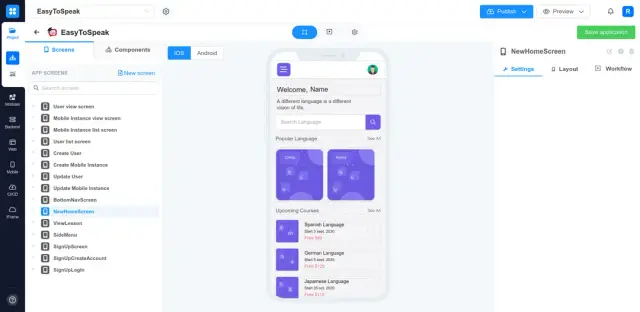
Educators are not limited to cookie-cutter solutions; they can tailor every aspect of the application to meet their pedagogical approach. Hyper-personalization becomes feasible with AppMaster, where algorithms can adapt to different learning styles, pacing, and content delivery preferences, creating a learning experience that resonates with the diverse needs of students.
The platform recognizes the significance of seamless integration and automation. Sifting through the maze of administrative duties and data, AppMaster helps instructors automate mundane tasks like attendance tracking and grading, leaving more room for meaningful educator-student interaction. In addition, the platform's ability to generate real applications means that these tools are not just temporary fixes; they're long-term educational assets.
Collaboration is key in education, and AppMaster empowers educators to collaborate on application development without barriers. Whether it’s sharing best practices or co-creating applications with colleagues, the platform fosters a community-centric approach to educational technology, further enriching the shared knowledge base and elevating classroom experiences across institutions.
The journey from concept to classroom application is significantly accelerated with AppMaster. The platform's efficiency in application creation ensures that innovative ideas can be rapidly prototyped, tested, and deployed, catering to the dynamic education sphere where learning paradigms constantly evolve.
Privacy and data security, a paramount concern in education, are adeptly managed within the platform. AppMaster ensures that educators have control over their data, with generated applications maintaining compliance with data protection standards and regulations, an assurance that fortifies the trust placed in digital education tools.
With the spotlight on future-readiness and equipping students with 21st-century skills, the role of a platform like AppMaster is indispensable. By harnessing the power of AI and no-code development, educators are not just passive recipients of technological advancements — they become active creators, molding the very fabric of educational innovation.
As the ethos of education evolves with technological advancements, educators empowered by tools like AppMaster are at the forefront, shaping a future where AI and human ingenuity coalesce to foster unparalleled learning experiences. This is education reimagined, where every classroom has the potential to be a cradle of innovation.
The education sector is ripe for a technological revolution, and the advent of low-code artificial intelligence (AI) platforms is a significant catalyst in this transformation. One particularly empowering aspect for educators is the ability to create custom educational tools. These tools, tailored to both the curriculum and the unique dynamics of their classrooms, can profoundly impact how educators teach and students learn.
Every classroom is a microcosm with its distinct blend of student personalities, learning paces, and educational objectives. This diversity calls for teaching tools that are not one-size-fits-all but are adaptable to various teaching strategies and student needs. Low-code AI platforms allow educators to personalize aspects of their teaching materials, which is invaluable for fostering an inclusive and effective learning environment.
Low-code platforms empower educators to step into the role of innovators. With an intuitive approach to app creation, educators can craft diverse and rich tools ranging from interactive quizzes and educational games to comprehensive learning management systems. This flexibility in design means that tools can grow and evolve alongside the educational curriculum.
AI is the driving force behind personalized education. By harnessing machine learning algorithms, educators can create systems that adapt to individual student performance, suggest tailored resources, and provide predictive insights into learning outcomes. The ability to customize tools on this level with low-code platforms revolutionizes the individual learning experience, making education more accessible and impactful.
Platforms such as AppMaster are a gateway for educators eager to adopt new technologies in their teaching practice but lack extensive IT training. AppMaster's visual programming and drag-and-drop interfaces simplify the complex processes of traditional coding, allowing educators to focus on what they know best: creating engaging and informative content for their students.
With AppMaster, creating a custom educational tool does not only stop at functionality. It also ensures generated applications are scalable and secure, instilling confidence in the educators and students that their data is protected and the tools will perform reliably even as class sizes grow or educational needs change.
Using low-code platforms to develop educational tools also encourages a culture of collaboration. Students and other educators can provide direct feedback, which can be swiftly acted upon to tweak and improve the tools. This collaborative and iterative process ensures the tools remain relevant and effective.
As these platforms evolve, they offer an even wider range of capabilities, ensuring that educators have the best tools at their disposal. Exciting developments in AI, such as natural language understanding and advanced analytics, hint at even more potent and effective educational resources soon.
The significance of low-code AI platforms cannot be understated in a sector where innovation translates directly to enhanced learning outcomes. They not only make cutting-edge technology accessible for educators but also herald a new age of personalized, effective, and dynamic education.
While the integration of low-code AI in education opens up a realm of possibilities for enhancing the learning experience, it does not come without its set of challenges and considerations. Stakeholders in the educational sector must address a range of concerns to ensure the successful adoption and effective use of such transformative technologies.
One of the primary barriers is the technical literacy required to leverage low-code AI platforms to their full potential. Educators may have varying degrees of familiarity with technology, and the prospect of integrating AI into their instruction can be intimidating. Professional development and continuous technical support are crucial for empowering teachers to confidently use these tools. As educators become more comfortable with low-code solutions, they can more effectively integrate AI into their curriculum, reaping the benefits of personalized instruction and automated administrative tasks.
Data privacy and security are paramount in any educational setting. The use of AI systems inherently involves the processing and storage of sensitive student information. Depending on the region, low-code AI platforms must abide by strict data protection regulations, such as GDPR, FERPA, and COPPA. Educators must diligently select platforms that offer strong security features to protect student data from unauthorized access and breaches.
The temptation to adopt AI for its novelty must be tempered by a sharp focus on the quality and relevancy of applications. Not all AI-driven solutions are created equal, nor are they always aligned with educational goals. Evaluating AI tools for their pedagogical value is necessary, ensuring they complement and enhance educational content rather than distract from it.
Equitable access to technology is a persistent challenge in education. There's a risk that low-code AI platforms could widen the digital divide if not implemented thoughtfully. Schools and districts must work to ensure that all students have the necessary resources and support to benefit from AI-enhanced education, including access to devices and reliable internet connectivity.
Any technological tool used in the classroom must align with curriculum standards and learning objectives. Educators will need to integrate AI tools in ways that reliably support mandated educational outcomes. This sometimes necessitates customization, which low-code platforms can facilitate, but it also requires ongoing review and adaptation as standards evolve.
The ethical implications of AI in education must be critically examined. This includes concerns over the potential for AI to perpetuate biases, the effects on student agency and creativity, and the balance between automated and human interactions in the learning process. Educators and developers need to collaborate to ensure that AI tools are designed and used ethically, placing the well-being of students at the forefront.
Ongoing collaboration between educators, policymakers, technical experts, and platform providers like AppMaster is vital to navigating these challenges. The collective goal should be to harness low-code AI to maximize educational benefits while minimizing risks, ensuring that the technology acts as a tool for empowerment rather than a source of inequity or contention in the classroom.
As we stand on the brink of a new era in the education sector, artificial intelligence (AI) is poised to redefine the traditional pedagogical paradigms. The world of education is no stranger to evolution, from the days of slate tablets to our current digital classrooms; however, the integration of AI promises a future that is at once exhilarating and replete with untapped potential. While low-code AI platforms like AppMaster have begun to sketch the blueprint of what's possible, the boundaries are continually expanding.
A cardinal arena where AI is expected to flourish within educational systems is personalized learning. The latest AI models are being envisioned to evaluate each student's unique learning pace, style, and interests. The eventual goal is to create adaptive learning platforms that can modify content delivery in real-time, based on student responses and engagement levels. Imagine an educational environment where AI seamlessly orchestrates the curriculum around the learner, rather than the learner striving to adapt to a static syllabus.
Augmented Reality (AR) and Virtual Reality (VR) are indisputably the torchbearers of immersive education. When married with AI, these technologies can transport students to ancient civilizations, deep ocean trenches, or even the outer reaches of the solar system—all within the confines of their classroom. AI will facilitate dynamic interaction within these virtualized environments, enabling students to glean insights through experiential learning that caters to all senses.
As AI technology matures, its involvement in curriculum development and assessment is anticipated to become more pronounced. AI algorithms will be able to sift through vast amounts of academic research and data to help educators identify the most effective teaching strategies and learning interventions. Furthermore, AI could automate the benchmarking and assessment process, offering educators detailed analytics on student performance, fostering a classroom where teaching strategies are continually iterated and improved.
Future iterations of AI in education may extend beyond academic intelligence and delve into the realms of emotional and cognitive awareness. Empathetic AI systems, equipped with sentiment analysis, could detect subtleties in student communication and behavior, providing insights that could guide educators in supporting students emotionally and improving attention and retention in classes.
An equally pivotal trend embodies AI's potential to democratize education. By breaking down geographical barriers and leveraging AI-powered translation and tutoring systems, individuals across the globe could have access to quality education irrespective of their location. Remote learning, a model that has shown its importance during global crises such as the COVID-19 pandemic, might achieve new heights as AI brings interactive and individualized education to the remotest corners of our planet.
AI isn't only revolutionizing student learning; it also stands to transform teacher training. With insights gleaned from AI analysis, teachers can receive customized professional development, helping them hone their skills and methodologies. Moreover, as educators come to grips with AI tools through platforms like AppMaster, they will grow more comfortable leveraging AI in their teaching practices, thus nurturing a technologically advanced educational workforce.
While filled with promise, the educational sphere ahead poses its unique challenges. Educators, policymakers, and technology developers must work in tandem, addressing privacy, ethics, and inclusivity concerns. Above all, as AI reshapes the face of education, the human element — compassion, creativity, and critical thinking — must remain at its core. With AI as a valuable tool, the future of education shines bright, heralding a new age of personalized, immersive, and universally accessible learning.
 What is low-code AI and how can it benefit education?
Low-code AI refers to platforms that allow users to develop and integrate artificial intelligence functionalities into applications with minimal coding. It benefits education by simplifying the creation of sophisticated AI tools, making technology accessible for educators to enhance interactive teaching and personalized learning experiences.
Can educators without a technical background use low-code AI?Yes, low-code AI platforms are designed to be user-friendly and accessible, even for educators with little to no technical background. Such platforms often provide drag-and-drop interfaces and pre-built templates for easier creation and integration of AI components into educational content.
How does low-code AI improve classroom learning?Low-code AI improves classroom learning by providing personalized educational experiences, automating administrative tasks, offering insights into student performance, and facilitating interactive and engaging content, which can help increase student motivation and improve learning outcomes.
What are some examples of low-code AI applications in education?Examples include personalized learning platforms, automated grading systems, chatbots for student support, interactive simulation tools, and platforms for monitoring students' progress and adapting instruction methods to suit individual learning styles.
How does AppMaster fit into the educational low-code AI space?AppMaster is a no-code platform that enables educators to rapidly create, deploy, and maintain web, mobile, and backend applications. With its visual programming environment, teachers can integrate AI capabilities into educational tools without extensive programming knowledge, fostering innovation in the classroom.
Can low-code AI platforms be used to develop full-fledged educational software?Yes, low-code AI platforms are sophisticated enough to support the development of comprehensive educational software that can range from simple interactive teaching aids to complex learning management systems with AI-driven analytics and personalization features.
What challenges might educators face when adopting low-code AI?Educators may encounter challenges such as limited understanding of AI concepts, the need for initial training to use the platforms effectively, potential data privacy concerns, and ensuring that the AI tools align with educational goals and curricula.
How will AI in education evolve in the future?The role of AI in education is expected to grow significantly, with advances in technology leading to more sophisticated AI tools that can aid in curriculum development, provide immersive learning experiences with augmented and virtual reality, and further personalize education by adapting to students' cognitive and emotional states.
Experiment with AppMaster with free plan.
When you will be ready you can choose the proper subscription.
 Jul 14, 20268 min
 Jul 13, 20268 min
 Jul 08, 20268 min