


 Jul 14, 2026
 8 min
8 minEquipment reservation app: prevent conflicts and track returns
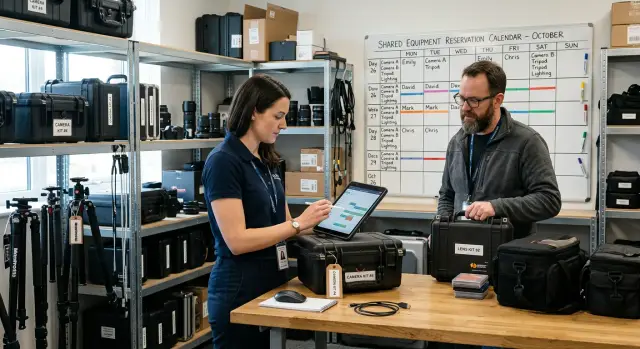
Plan an equipment reservation app that prevents double bookings, records returns and damage, and places faulty items on maintenance hold.

Discover how the no-code development and artificial intelligence revolution can transform your business. Explore various AI-focused no-code platforms, AppMaster.io, and AI integrations.

No-code development is a revolutionary approach to software development, enabling users to create software applications without writing a single line of code. By visually constructing data models, business logic, and user interfaces using drag-and-drop elements, developers and non-technical users alike can build powerful applications quickly and efficiently. No-code platforms, like AppMaster.io, provide users with all the necessary tools to build web, mobile, and backend applications with ease.

Artificial Intelligence (AI) is another breakthrough technology that has transformed various aspects of our daily lives. AI systems are designed to learn from data, recognize patterns, make decisions, and perform tasks with minimal human intervention. By incorporating AI into no-code development, businesses can leverage the power of both technologies to create smarter, more adaptable solutions that meet their dynamic needs. When combined, no-code development and AI enable users to:
Various no-code platforms have emerged that specifically focus on AI functionalities. These platforms allow users to develop a wide range of customized applications with powerful AI capabilities integrated into their workflows. Some examples of AI-powered no-code platforms include:
DataRobot is an AI-driven no-code platform that enables users to develop, deploy, and manage machine learning models with ease. Its user-friendly interface and automated machine learning capabilities make it simple for users of all skill levels to create predictive models. With DataRobot, users can leverage AI to analyze vast amounts of data for better decision-making, forecast future trends, and improve their business processes.
H2O.ai is a leading open-source AI platform, offering an automated machine learning solution that simplifies the process of developing AI applications. With its drag-and-drop interface, H2O.ai allows users to create, train, and deploy machine learning models without any prior coding or data science experience. Its advanced AI capabilities can be applied to a wide range of use cases, such as customer churn prediction, fraud detection, and sentiment analysis.
Teneo is a no-code platform that specializes in natural language processing (NLP) and conversational AI. By using Teneo's visual interface, users can build highly interactive chatbots, virtual assistants, and other conversational applications with ease. The platform's advanced NLP capabilities enable users to create sophisticated, human-like conversations that guide customers, answer questions, and offer support at any time of day.
Integrating AI services into your no-code applications can unlock new possibilities, enhancing your projects with machine learning, NLP, computer vision, and other AI-driven capabilities. Many popular no-code platforms, including AppMaster.io, allow users to seamlessly integrate AI services from third-party AI providers, such as Google Cloud, Amazon Web Services (AWS), and Microsoft Azure. Examples of AI integrations for no-code applications include:
As the no-code development and AI industries continue to grow and evolve, businesses must adapt to leverage the powerful combination these technologies offer, unlocking new possibilities for innovation and growth. By understanding the various AI-focused no-code platforms and AI integrations available, you can unleash the full potential of your no-code applications and drive your business to new heights.
AppMaster.io is a powerful no-code platform that enables you to create backend, web, and mobile applications without writing any code. It offers extensive tools and features, allowing users to visually construct data models, business logic, and UI components. But what if you want to add Artificial Intelligence (AI) capabilities to your applications built with AppMaster.io?
Integrating AI functionalities is a straightforward process with AppMaster.io. The platform facilitates seamless integration with popular AI services offered by providers like Google Cloud, Amazon Web Services (AWS), and Microsoft Azure. These providers offer a plethora of AI features such as machine learning, natural language processing, computer vision, and more.
Here's a step-by-step guide on how to bring AI into your AppMaster.io projects:
As incredible as the combination of no-code development and AI is, it has its fair share of challenges and opportunities. Here's what you need to be aware of as you venture into the world of AI-powered no-code applications:
No-code AI applications can revolutionize your business processes, streamline your workflows, and deliver tangible results. Adapting your business strategy to fully embrace these powerful technologies is vital for staying competitive in today's rapidly evolving digital environment. Here's how you can align your business strategy with no-code AI applications:
Integrating AI capabilities in no-code applications presents vast opportunities for businesses. The right combination can help develop advanced solutions, streamline operations, and improve decision-making. By leveraging the power of AppMaster.io and other AI-focused no-code platforms, you can successfully bring AI to your projects and tap into the full potential of this technological synergy.
 What is no-code development?
No-code development is a method of building software applications without the need to write any code. It enables users to create applications by visually constructing data models, business logic, and user interfaces using drag-and-drop elements.
How does artificial intelligence (AI) enhance no-code development?AI can automate various aspects of no-code development, such as data analysis, predictions, and providing real-time insights. The combination of AI and no-code development can help create smarter, more adaptable applications that meet dynamic business needs.
What are some examples of AI-powered no-code platforms?Examples of AI-powered no-code platforms include DataRobot, H2O.ai, and Teneo. These platforms offer AI-focused no-code solutions that enable users to develop customized applications with powerful AI capabilities integrated into their workflows.
How can I integrate AI into my AppMaster.io projects?AppMaster.io's no-code platform allows you to seamlessly integrate AI services like machine learning, natural language processing, and computer vision from AI providers such as Google Cloud, Amazon Web Services, and Microsoft Azure.
What are the main challenges in combining AI and no-code development?Challenges in combining AI and no-code development include the need for better AI knowledge and understanding amongst no-code users, data privacy concerns, managing AI system complexity, and ensuring the optimal performance of AI-driven applications.
How can businesses adapt their strategies for no-code AI applications?Businesses can adapt their strategies by embracing no-code AI applications for automation and improvement of business processes, investing in AI technology research and development, and offering training programs to educate employees on the applications and best practices of AI in no-code development.
Experiment with AppMaster with free plan.
When you will be ready you can choose the proper subscription.
 Jul 14, 20268 min
 Jul 13, 20268 min
 Jul 08, 20268 min