


 Jul 14, 2026
 8 min
8 minEquipment reservation app: prevent conflicts and track returns
Plan an equipment reservation app that prevents double bookings, records returns and damage, and places faulty items on maintenance hold.

Increase the security of your application with IP Filter module.
The IP Filter module adds IP Filter middleware to your application. It does not require additional settings - you just need to install it.
Middleware IP Filter extends the endpoint settings in your application. With it, you can set access to endpoints only from specific IP addresses or prohibit it for certain IPs.
This will increase the security level of your application and be able to better control the processes occurring in it.
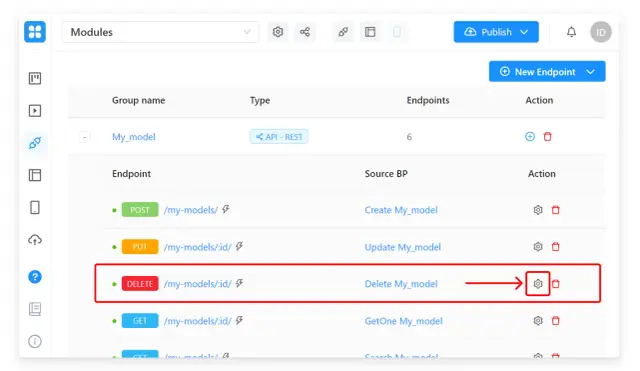
In AppMaster.io Studio, go to the Endpoints tab and find the endpoint for which you want to configure access.
1. Click on the gear icon next to its name.
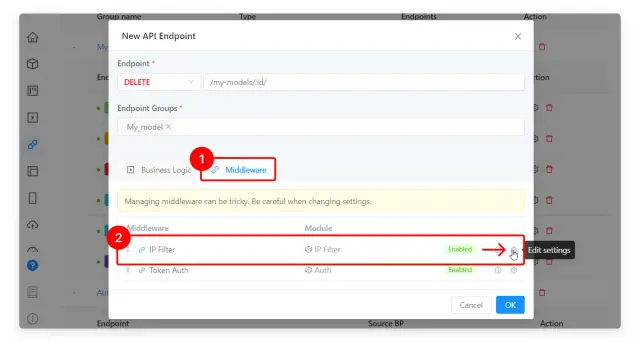
2. Go to the Middleware tab (1), find IP Filter in the list, and open its settings (2).
3. In the Mode field, select one of the options:
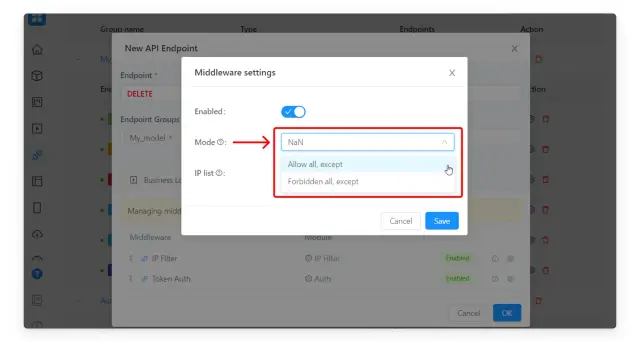
4. In the IP list field, enter an address or a list of addresses separated by commas.
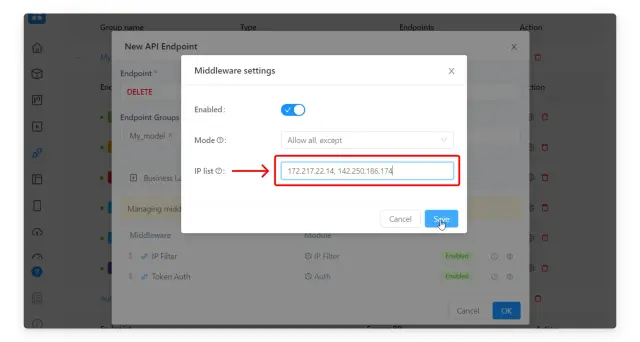
Thus, configure all the endpoints to which you want to restrict access.
Here are some examples of using IP Filter.
Let's imagine that your application provides an API for communicating within a specific network. Most likely, in this case, you do not need authorization (so as not to complicate access to the API), but at the same time, you need to restrict the list of IP addresses (allow strictly defined services to access your application). Use the "Forbidden all, except" mode.
Let's imagine that you need to restrict access to your application for attackers who send spam, try to guess passwords, or carry out DDoS attacks. Information about their IP addresses will be displayed in the logs. Add these IP addresses to the list of prohibited endpoints for enabled endpoints by setting the "Allow all, except" mode in the IP Filter settings. For example, if there are many unsuccessful authorization requests from a specific IP, most likely someone is trying to guess the password. Deny him authorization by setting access restrictions to the POST/auth endpoint (Auth group).
Learn more about what endpoints are and how to use them in our documentation. For more how-tos and helpful materials, visit the AppMaster.io blog.
Subscribe to the AppMaster.io telegram channel and join our community chat - here you can find out the latest platform news and communicate directly with our developers.
 How do I add IP filtering to an endpoint?
Install the module, then open the endpoint settings in AppMaster Studio and select IP Filter on the Middleware tab. Choose a mode and enter the IP addresses that should be allowed or blocked.
Which IP Filter mode should I choose?Use "Forbidden all, except" when only listed IP addresses should reach the endpoint. Use "Allow all, except" when everyone can access it except the IPs you list.
Can I add more than one IP address?Enter one address or several addresses in the IP list field. Separate multiple IP addresses with commas so the filter can apply the same rule to each one.
Does IP Filter apply to every endpoint automatically?No. You configure IP Filter per endpoint, so apply it to every endpoint that needs its own access rule. This lets you protect sensitive routes without limiting unrelated ones.
How can I limit an API to trusted services only?For an internal API used by a small set of known services, choose "Forbidden all, except" and list those services' IP addresses. Requests from any other address will not reach that endpoint.
How do I block a suspicious IP address?Check your application logs for repeated failed requests, spam, or suspicious traffic from the same address. Add that address to an "Allow all, except" rule on the affected endpoint.
Can IP Filter help with password-guessing attempts?Apply an "Allow all, except" rule to the POST/auth endpoint and add the offending address. This blocks that source from sending more login attempts to that route.
Do I still need authentication if I use IP filtering?IP filtering controls where a request can come from. It does not replace authentication when users or services need identity-based access control, especially if approved IP addresses can change or be shared.
Does the IP Filter module need setup after installation?No extra module settings are required before use. After installation, configure the rule where it matters: in the middleware settings for each chosen endpoint.
Will IP filtering stop DDoS attacks?It can reduce unwanted traffic from known sources, but it cannot stop every attack by itself. Combine it with authentication, sensible endpoint rules, and log monitoring.
Experiment with AppMaster with free plan.
When you will be ready you can choose the proper subscription.
 Jul 14, 20268 min
 Jul 13, 20268 min
 Jul 08, 20268 min