


 Jul 14, 2026
 8 min
8 minEquipment reservation app: prevent conflicts and track returns
Plan an equipment reservation app that prevents double bookings, records returns and damage, and places faulty items on maintenance hold.

Explore Google's Site Reliability Engineering (SRE) principles, how they affect software architecture, and how developers can implement them for better scalability and enhanced performance.

Site Reliability Engineering (SRE) is a software engineering discipline that designs, maintains, and operates scalable and highly available software systems. The SRE principles have their roots in Google, which has set a benchmark for industry-leading software reliability and performance. These principles have helped Google achieve unparalleled system availability, incident response, and resource usage efficiency.
Implementing Google's SRE principles enhances software architecture by driving better system reliability, lower latency, improved resource management, and minimal technical debt. Developers who embrace these practices proactively address potential issues and reduce the operational burden, resulting in better customer experience and business growth.
When it comes to software architecture, several SRE principles play a significant role. Let's review these key principles and how they can be applied to improve your development process:
Service Level Agreements (SLAs) establish a mutual understanding between the service provider and the customers concerning the level of service expected and the performance objectives. In SRE, SLAs are accompanied by Service Level Objectives (SLOs), which represent target values for system performance and availability. A well-designed software architecture should focus on defining SLAs and SLOs to set clear expectations for system performance. These metrics help identify potential architectural bottlenecks and ensure the system meets user requirements.
Error budgets are a concept introduced in SRE that enables engineers to balance the level of acceptable risk with the need for innovation. An error budget is the acceptable amount of unreliability allowed in a system, usually expressed as a percentage of time or requests. In software architecture, incorporating error budgets helps understand the trade-offs between system stability and feature development. It prompts developers to assess the impact of new features and architectural changes on the system's overall reliability.
Blameless postmortems establish a culture that learns from system failures without attributing fault. The process involves analyzing incidents, identifying the contributing factors, and implementing corrective actions to prevent future occurrences. Applying blameless postmortems in your software architecture ensures that your team works constructively towards improving the system's resilience, without getting bogged down in finger-pointing. This approach fosters a culture of continuous improvement and shared responsibility for system stability.
Toil is the manual, repetitive work that adds no long-term value to a service but must be performed for the software system to function. SRE principles advocate for automating toil-heavy tasks wherever possible to reduce human intervention and free up developer resources for strategic initiatives. In software architecture, automating common tasks such as environment Management, configuration updates, and routine system maintenance can lead to a more streamlined and efficient development process, minimizing operational overhead.
Monitoring and observability are critical aspects of SRE that enable developers to understand the state of a system, detect issues proactively, and ensure optimal performance. Effective monitoring involves collecting and analyzing system health, performance, and user experience metrics. Incorporating monitoring and observability into software architecture helps engineers identify bottlenecks, proactively address issues and optimize application performance. This empowers teams to deliver reliable and high-performing software systems consistently.

Integrating Google's SRE principles into your software development process can be highly beneficial to your project's overall success. Here are some steps you can follow to implement SRE principles:
Continuous integration and deployment streamline the software development process by automating tasks like building, testing, and deploying code changes. This practice enables teams to deliver software features more efficiently and ensures that changes meet quality requirements before deployment. Implementing CI/CD also helps minimize technical debt and risk by providing rapid feedback on code changes.
Resiliency is the ability of a system to recover from failures and continue to provide an acceptable level of service. When implementing SRE principles, it's essential to design your software for resiliency by incorporating techniques such as redundancy, load balancing, circuit breakers, and fallbacks. This approach ensures that your system can handle failures gracefully and quickly recover, providing a reliable experience for your users.
As mentioned earlier, monitoring and observability are vital in ensuring software reliability and performance. Invest in monitoring tools and practices that provide visibility into your system's health and operation. Set up alerts and dashboards to detect issues proactively and respond quickly when issues arise.
Technical debt is the long-term costs associated with suboptimal design choices, code quality, or architecture decisions. Minimizing technical debt is essential to implementing SRE principles in your software development process. Regularly review and refactor code, prioritize tasks that reduce technical debt, and adopt best practices to ensure maintainability and extensibility of your software.
Embrace the SRE principle of blameless postmortems and create a culture where learning from failures is encouraged and valued. Analyze incidents, identify root causes, and implement changes to prevent similar issues from occurring in the future. This proactive approach helps improve system reliability and fosters a culture of continuous improvement.
Adopting Google's SRE principles in your software development process and architecture can lead to highly reliable and scalable systems. By focusing on key aspects like performance objectives, error budgets, automation, and learning from failures, you can deliver exceptional user experiences and drive business growth.
No-code platforms have already transformed the way developers approach software construction and deployment. These platforms simplify the development process, allowing rapid prototyping and deployment while adhering to SRE principles. The combination of SRE practices and no-code platforms makes it easier for developers to create, modify, and maintain scalable and reliable applications with less time and effort.
By adopting Google's SRE principles, no-code platforms can ensure enhanced performance, scalability, and reliability in the applications being developed. These platforms can automate mundane tasks, reducing toil and enabling developers to focus on higher-value work.
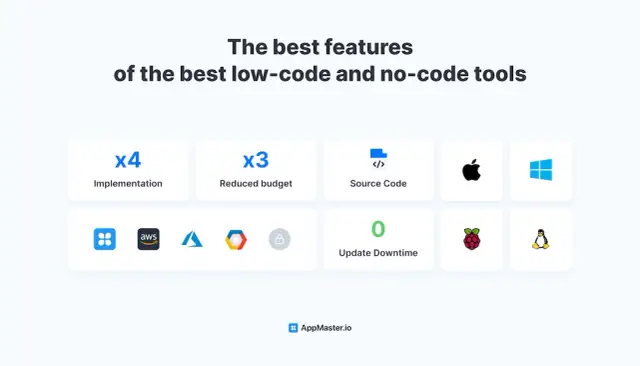
Furthermore, no-code tools follow a model-driven development approach, making it easier to maintain and evolve applications without raising technical debt. When adopting no-code tools that utilize SRE principles, developers can benefit from:
AppMaster, a leading no-code app development platform, is an excellent example of how Google's SRE principles can be implemented in a development environment. AppMaster has helped businesses build scalable, high-performing, and reliable applications quickly and cost-effectively by integrating SRE practices. By implementing SRE principles, AppMaster offers the following benefits to its users:
AppMaster's adherence to Google's SRE principles has helped the platform stand out from the competition and provided its users with a comprehensive, scalable, and reliable software solution that caters to their unique technical requirements.
Implementing Google's SRE principles into software architecture can help businesses significantly improve their applications' reliability, scalability, and performance. By embedding these principles into their development processes, developers can aim to reduce response times in the face of incidents, efficiently manage resources, and minimize technical debt.
Furthermore, the integration of SRE principles with no-code platforms, such as AppMaster, offers a powerful way to create applications that are easy to maintain, evolve and deploy, ultimately reducing time to market and increasing cost savings. By leveraging these practices, businesses can ensure that their software architectures are set up for success in today's highly competitive and data-driven world.
 What are Google's SRE principles?
Google's Site Reliability Engineering (SRE) principles are a set of practices and guidelines to enhance the scalability, reliability, and performance of software systems.
Why should developers consider implementing SRE principles?Implementing SRE principles can help developers achieve better system reliability, faster incident response, efficient resource usage, and reduced technical debt.
What are the key SRE practices?Some key SRE practices include service level agreements, failure budget, blameless postmortems, automation for toil reduction, and monitoring and observability.
How can SRE principles be applied to software architecture?Applying SRE principles to software architecture involves designing for scalability and reliability, creating a robust monitoring and observability system, managing resources efficiently, and reducing technical debt.
What role do no-code platforms like AppMaster play regarding SRE principles?No-code platforms like AppMaster simplify application development while adhering to SRE principles. They allow developers to create scalable and reliable applications with less time and effort.
How can developers implement SRE principles in their software development process?Developers can implement SRE principles by adopting continuous integration and deployment, designing for resiliency, improving monitoring and observability, minimizing technical debt, and learning from failures through blameless postmortems.
Which types of projects are suitable for implementing SRE principles?SRE principles are suitable for nearly any software project, from small-scale applications to large enterprise systems, as they help improve scalability, reliability, and performance.
How does AppMaster implement SRE principles?AppMaster follows SRE principles by generating applications from scratch whenever requirements are modified, eliminating technical debt, and offering scalability features essential for high-load scenarios.
Experiment with AppMaster with free plan.
When you will be ready you can choose the proper subscription.
 Jul 14, 20268 min
 Jul 13, 20268 min
 Jul 08, 20268 min