


 Jul 14, 2026
 8 min
8 minEquipment reservation app: prevent conflicts and track returns
Plan an equipment reservation app that prevents double bookings, records returns and damage, and places faulty items on maintenance hold.

Discover how low-code development can improve customer experience, streamline business processes, increase efficiency, and support innovation for your organization.

Low-code development has emerged as a game-changing approach in the world of software development, allowing businesses to rapidly build and deploy applications with minimal coding. By utilizing visual design tools and pre-built components, low-code development enables both technical and non-technical users to create applications with ease, making it an increasingly popular choice among organizations looking to improve their digital footprint. But how does low-code development impact customer experience?
In today's rapidly changing digital industry, delivering an exceptional customer experience is pivotal for any business's success. This is because a seamless and engaging user experience directly correlates with higher customer satisfaction, increased loyalty, and improved brand reputation. Consequently, businesses are continually looking for ways to enhance customer experiences, and low-code development platforms provide the perfect opportunity to do just that.
Low-code development platforms can significantly contribute to delivering a better customer experience in various ways, including:
Low-code platforms enable faster application development and deployment, allowing businesses to quickly adapt to customer needs and market trends. This rapid development cycle means that businesses can not only respond to customer feedback more efficiently but also proactively anticipate customer requirements and deliver innovative solutions that exceed their expectations.
Low-code platforms offer extensive customization options, empowering businesses to create tailored applications that cater to the needs of their customers. By providing a foundation for building customer-centric applications, low-code development platforms allow organizations to directly address the unique requirements and preferences of their target audience, leading to a more personalized and engaging customer experience.
Low-code platforms often come with built-in support for integrating with various existing systems, tools, and services, reducing the complexity of connecting various components seamlessly. This simplifies the process of integrating new customer-facing applications with an organization's existing infrastructure, ensuring a smooth and consistent experience for end-users.
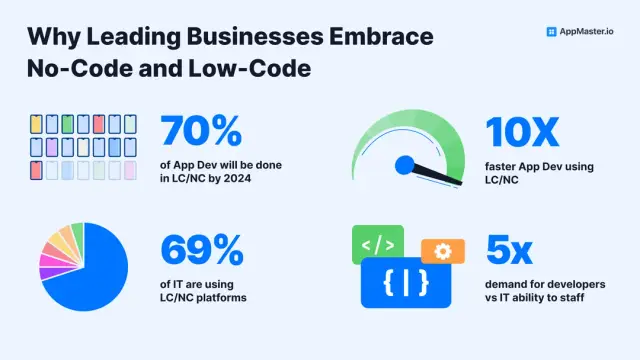
In addition to improving customer experience directly, low-code development also benefits businesses by streamlining internal operations, which ultimately leads to an enhanced user experience. Some of these operational improvements include:
While low-code/no-code development platforms offer a multitude of benefits for businesses looking to improve customer experience, it is essential to be strategic in selecting the right platform that aligns with a company's specific needs and objectives. One such versatile no-code platform is AppMaster.io, which will be discussed in the next section of the article. Whether streamlining business operations or directly enhancing customer experiences, the flexibility, efficiency, and speed of low-code/no-code development have a transformative impact on organization's capabilities.
AppMaster.io is a powerful no-code platform that supports the development of backend, web, and mobile applications, enabling organizations to improve customer experience substantially. Implementing a no-code solution like AppMaster.io allows businesses to create customer-centric applications through visual design tools, resulting in a seamless user experience. By providing a comprehensive suite of features and functionalities, AppMaster.io accelerates development processes, thus enabling organizations to save both time and resources.
With a breadth of useful features, such as data model creation, a visual BP (business process) designer, REST API support, and WSS endpoints, AppMaster.io makes it possible to develop rapid application prototypes and launch them on various platforms. By offering multiple subscription plans tailored to meet specific business requirements and budgets, AppMaster.io creates a flexible environment that enables the efficient development and deployment of applications to cater to customer needs.
AppMaster.io's approach of generating applications from scratch whenever requirements are changed eliminates technical debt and allows for faster development cycles. The platform's scalability and adaptability make it an attractive option for a wide range of customers, from small businesses to large enterprises.
As a no-code solution, AppMaster.io empowers organizations to create applications with improved user interfaces and experiences by cutting down on manual coding and using drag-and-drop tools. Companies can innovate and launch better customer-centric applications to meet their customers' ever-changing expectations, resulting in increased customer satisfaction and retention.
Low-code development offers numerous advantages in various aspects of software development and business operations, contributing to improvements in customer experience. Some of the top benefits of low-code solutions include:
When considering the adoption of low-code development for your organization, several factors should be taken into account to ensure a successful implementation. Here are a few key considerations:
Implementing low-code and no-code development platforms, like AppMaster.io, can lead to significant improvements in your organization's customer experience by streamlining business processes, fostering innovation, and enhancing overall efficiency. With the right considerations and due diligence, adopting low-code solutions can provide numerous benefits that directly impact a company's bottom line, making it a worthwhile investment.
In today's fast-paced, digital environment, customer experience has become increasingly important in differentiating businesses and driving growth. Low-code development plays a crucial role in ensuring that organizations can rapidly build and deploy customer-centric applications that enhance user experience, streamline operations, and support innovation.
Leveraging a no-code platform like AppMaster.io can empower organizations to develop applications 10 times faster and eliminate technical debt, creating a flexible and powerful foundation for continuous improvement in customer experience. By embracing low-code development, organizations can not only save time and resources but also become more agile, adaptive, and competitive in the market.
Overall, low-code development is a game-changing approach that has the potential to revolutionize customer experience across various industries. It allows businesses to innovate quickly and meet ever-changing customer needs, ultimately leading to greater customer satisfaction and long-term success. By investing in low-code platforms and solutions, businesses can build a strong foundation for delivering outstanding customer experiences and driving digital transformation.
 What is low-code development?
Low-code development is a software creation approach that allows developers and non-technical users to create applications using visual design tools and pre-built components. This method significantly reduces the amount of manual coding required and accelerates application development processes.
How can low-code development improve customer experience?Low-code development can improve customer experience by streamlining business operations, increasing efficiency, enabling rapid application development, and fostering innovation. This allows organizations to create customer-centric applications that cater to customer needs and provide a seamless user experience.
What are the benefits of low-code development?Some key benefits of low-code development include rapid application development, lower development costs, reduced technical debt, easier maintenance and updates, improved collaboration between IT and business teams, and enhanced digital innovation.
How does low-code development streamline business operations?Low-code development streamlines business operations by enabling automation, integrating data and applications, and reducing complexities in app development. This empowers organizations to rapidly build and deploy applications, leading to improved efficiency and customer experience.
What should I consider when adopting low-code development?When adopting low-code development, consider your organization's specific needs and challenges, the scalability and flexibility of the low-code platform, integration with existing systems, and long-term costs and potential ROI.
How does AppMaster.io support low-code development and customer experience improvement?AppMaster.io, a powerful no-code platform, enables users to visually create data models, business processes, and UI for web, mobile, and back-end applications. By speeding up development processes and eliminating technical debt, AppMaster.io allows organizations to create customer-centric applications that provide a seamless user experience.
Experiment with AppMaster with free plan.
When you will be ready you can choose the proper subscription.
 Jul 14, 20268 min
 Jul 13, 20268 min
 Jul 08, 20268 min