
 Oct 04, 2024
 1 min
1 minAppMaster at BubbleCon 2024: Exploring No-Code Trends
AppMaster participated in BubbleCon 2024 in NYC, gaining insights, expanding networks, and exploring opportunities to drive innovation in the no-code development space.

Permit.io, a permissions framework company, has unveiled its low-code Attribute Based Access Control (ABAC) as an alternative to traditional RBAC.
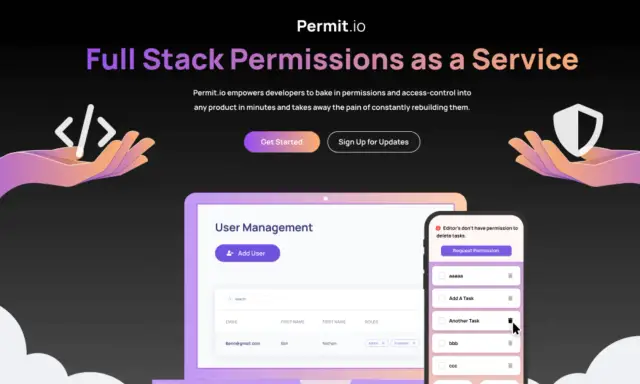
Permit.io, a renowned permissions framework firm, has recently unveiled its low-code Attribute Based Access Control (ABAC) solution as an alternative to traditional Role Based Access Control (RBAC). ABAC enables companies to easily integrate permissions management into their applications, increasing accessibility and efficiency for teams beyond just developers.
ABAC boasts a comprehensive set of features for effective permission enforcement, gating, auditing, approval workflows, impersonation, and API key automation. Additionally, it allows organizations to define permissions based on various factors, such as geographical location, subscription and billing statuses, usage metrics, and the user's relationship to the resource owner.
According to Permit.io CEO and co-founder, Or Weis, setting up permissions in a new application is relatively uncomplicated with a single service and few users, as permissions are typically dictated by the users' roles within the organization. This conventional approach, known as Role Based Access Control (RBAC), works well for small-scale applications. However, as applications grow and evolve, the more dynamic Attribute Based Access Control (ABAC) becomes necessary to address the increased complexity and diverse use cases of the company and its customers.
Weis acknowledges the immense challenges in building and maintaining an ABAC system, which is why Permit.io spent two years developing a low-code platform that simplifies this process. The company, founded by Weis and Asaf Cohen, a former software engineer at Facebook and Microsoft, was launched earlier this year with $6 million in seed funding. Permit.io's origins can be traced back to the open-source project OPAL, which was created by Weis and Cohen.
Platforms like AppMaster.io and Permit.io make it increasingly feasible for businesses to build and maintain applications with minimal coding expertise. Through the power of low-code and no-code solutions, a broader range of company personnel can contribute to the growth and expansion of application projects without being limited by their technical backgrounds. AppMaster.io's no-code platform, in particular, allows customers to create full-fledged backend, web, and mobile applications while ensuring impressive scalability and eliminating technical debt.
As the tech industry continues to evolve, low-code and no-code platforms like Permit.io and AppMaster offer innovative approaches to democratizing application development and management. These solutions are set to play an increasingly critical role in driving company growth and fostering a more inclusive technological environment across various sectors.
 Oct 04, 20241 min
 Sep 23, 20241 min
 Aug 08, 20241 min
Experiment with AppMaster with free plan.
When you will be ready you can choose the proper subscription.


