
 Oct 04, 2024
 1 min
1 minAppMaster at BubbleCon 2024: Exploring No-Code Trends
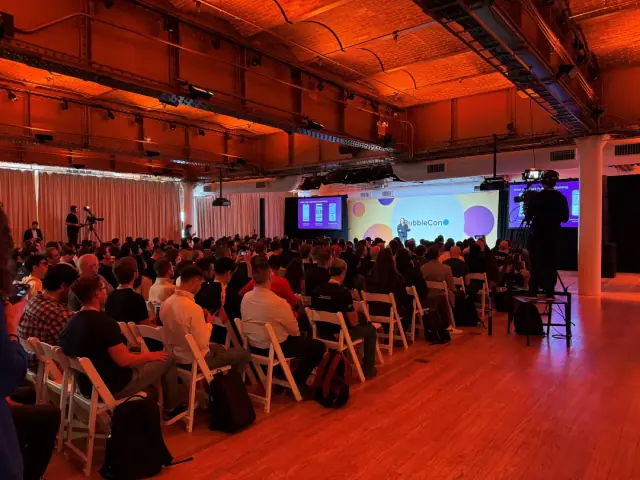
AppMaster participated in BubbleCon 2024 in NYC, gaining insights, expanding networks, and exploring opportunities to drive innovation in the no-code development space.

A recent survey by Mendix suggests that low-code technology will surpass traditional coding by 2024, in line with Gartner's prediction that 70% of enterprise applications will be created using low-code or no-code platforms. The pandemic has significantly changed the way businesses operate, increasing the need for digitalization and making low-code development essential.

Business leaders believe that by 2024, low-code development will outpace traditional coding in enterprise applications. This expectation is supported by a recent survey conducted by Mendix, and it aligns with Gartner projections that 70% of applications developed by enterprises will use low-code or no-code technologies by 2025, a significant increase from less than 25% in 2020.
Tim Srock, CEO of Mendix, explains how the business landscape has fundamentally changed over the past two years, making digitalization crucial for success. He says, It is now absolutely critical to digitalize operations and engage with customers and employees through different modalities and touchpoints. At the same time, growing technology complexity and the accelerating speed of business necessitate the use of low-code to ensure that delivering business value is technologically possible and can be achieved in a fast and agile way.
The Mendix survey revealed that low-code has evolved from a crisis technology during the pandemic to a core technology today. About 69% of respondent organizations consider low-code crucial for their businesses, with 94% of these companies currently utilizing low-code platforms, up from 77% in 2021. Among the surveyed professionals, 70% consider low-code a central part of their businesses.
In 2022, low-code is accelerating the development of various applications, such as customer portals, productivity apps, and enterprise-grade software. It is interesting to note that four in 10 respondents use low-code for mission-critical apps. The top three sectors demanding low-code solutions are IT (50%), production engineering (43%), and product design and quality control.
Nearly one-third of respondents expressed dissatisfaction with their company's legacy systems, prompting 39% of them to require proof that low-code will effectively integrate with existing systems. A majority, 63%, of respondents have leveraged low-code to address transportation, logistics, and supply chain challenges.
According to the survey, the top two perceived benefits of low-code in manufacturing are improved real-time process visibility (39%) and improved real-time data visibility (38%). The top three production use cases include peer-to-peer sharing apps, connectivity to shop floor devices, and connectivity to existing commercial software.
Platforms like AppMaster offer efficient low-code and no-code development opportunities, enabling businesses to create backend, web, and mobile applications through a visual, user-friendly interface. Its comprehensive capabilities have made AppMaster a popular choice in the industry, garnering over 60,000 users as of April 2023 and earning recognition from G2 as a High Performer in numerous categories.
As the demand for low-code development continues to grow, platforms like AppMaster will play a crucial role in enabling enterprises to create agile, scalable solutions and drive digital transformation at an accelerated pace.
 Oct 04, 20241 min
 Sep 23, 20241 min
 Aug 08, 20241 min
Experiment with AppMaster with free plan.
When you will be ready you can choose the proper subscription.


