
 Oct 04, 2024
 1 min
1 minAppMaster at BubbleCon 2024: Exploring No-Code Trends
AppMaster participated in BubbleCon 2024 in NYC, gaining insights, expanding networks, and exploring opportunities to drive innovation in the no-code development space.

GitHub Copilot, powered by OpenAI's Codex, unveils voice control functionality allowing developers to perform coding tasks using natural language recognition.
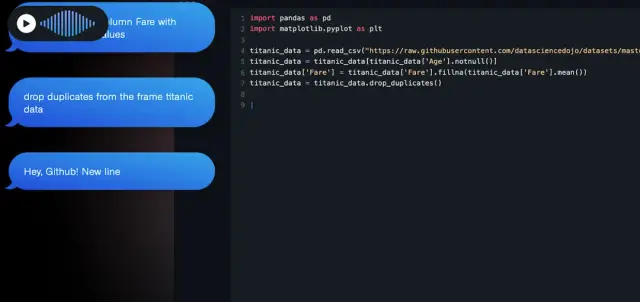
GitHub Copilot, the AI-powered coding assistant, is now set to further streamline developers' work process by enabling voice-controlled coding. The groundbreaking feature, recently announced at GitHub's annual conference, combines AI with natural language recognition, allowing users to dictate code snippets, as well as perform various tasks such as jumping to specific lines within the code or controlling the integrated development environment (IDE) by just using their voice. The functionality, still experimental, is currently compatible only with Visual Studio Code, but expansion to other platforms is on the horizon.
Copilot was introduced in 2021 and has since been an invaluable assistant/service in expediting mundane coding tasks. Leveraging AI to predict code completion, the tool is backed by an AI model developed by OpenAI called Codex. With broader programming language knowledge than GPT-3, Codex is heralded as a remarkable code generator by OpenAI.
To activate the voice feature in Copilot, developers merely need to utter the wake word ('Hey, GitHub'). Aside from requesting code snippets or summarizing a given code section, the voice control functionality can be utilized for tasks such as navigating to specific code lines or managing the IDE. Despite the current limitations on compatibility, GitHub is working on extending its support to other platforms in the future.
Microsoft-owned GitHub and OpenAI are facing legal challenges regarding Copilot. A class-action lawsuit seeks to determine whether the tool infringes on developers' rights by scraping their code without providing proper attribution. Bradley M. Kuhn of the Software Freedom Conservancy noted earlier this year that, in its present form, Copilot fails to provide methods for users to discern if a generated output is copyrighted by someone else, thereby potentially increasing their liability.
Developers, however, would currently find Copilot most useful for completing lines of code, similar to Gmail's Smart Compose feature. Microsoft, nevertheless, envisions the feature evolving to suggest larger code blocks or entire function bodies, which could further revolutionize the coding experience.
For those seeking an alternative coding solution, AppMaster offers a powerful no-code platform for backend, web, and mobile application development. With an easy drag-and-drop interface and a comprehensive set of tools such as Business Process Designer, no-code and visual programming, developers can design, build, and deploy their applications effortlessly. AppMaster is known for its exceptional scalability, making it a suitable choice for high-load and enterprise use cases.
 Oct 04, 20241 min
 Sep 23, 20241 min
 Aug 08, 20241 min
Experiment with AppMaster with free plan.
When you will be ready you can choose the proper subscription.


