
 Oct 04, 2024
 1 min
1 minAppMaster at BubbleCon 2024: Exploring No-Code Trends
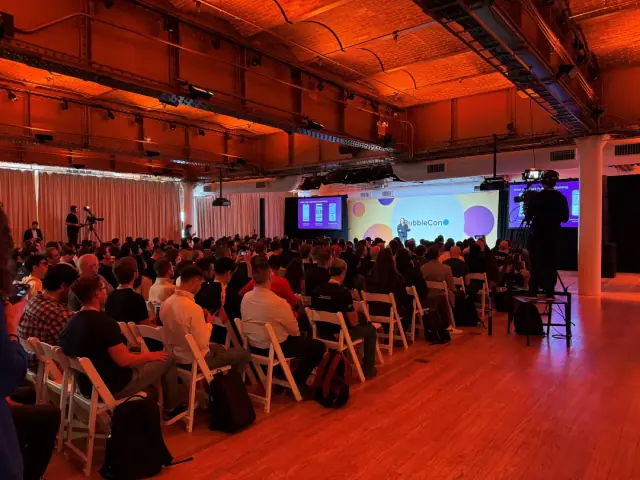
AppMaster participated in BubbleCon 2024 in NYC, gaining insights, expanding networks, and exploring opportunities to drive innovation in the no-code development space.

DeepMind's RoboCat AI model demonstrates the ability to solve and adapt to multiple tasks on a variety of real-world robots.

DeepMind recently announced the creation of RoboCat, an AI model that can efficiently perform a multitude of tasks utilizing multiple real-world robotic arms. This groundbreaking innovation is the first of its kind to efficiently tackle several assignments while adapting to different robotic models, potentially lowering the barrier for solving new tasks in robotics.
RoboCat was developed based on DeepMind's previous model called Gato, which functions as an AI system capable of analyzing and interacting with text, images, and events. It was trained on image and action data from both simulated and real-life robotics. The data used for training comprises robot-controlling models within virtual environments, human-controlled robots, and prior iterations of RoboCat.
Researchers initiated the training by gathering 100 to 1,000 demonstrations of tasks or teaching robotic arms controlled by humans. Subsequently, RoboCat was fine-tuned on the task, creating specialized spin-off models that practiced the task around 10,000 times. By growing RoboCat's training dataset using spin-off model data and demonstration data, they generated newer versions of the AI model.
The final version of RoboCat was trained on a total of 253 tasks and then benchmarked on a set of 141 variations of these tasks in simulation and real-world scenarios. DeepMind found that after observing 1,000 human-controlled demonstrations, RoboCat was adept at operating different types of robotic arms. Moreover, despite being trained on robots with two-pronged arms, the AI model could adapt to a more complex arm with a three-fingered gripper and twice as many controllable inputs.
However, the model's success rate varied drastically from 13% to 99% across multiple tasks depending on the number of demonstrations included in the training data. Nonetheless, DeepMind revealed that RoboCat could learn new tasks with as few as 100 demonstrations in some cases.
The research team's future goals include reducing the number of demonstrations necessary to teach RoboCat a new task to less than ten. As the development of AI models assisting in robotic tasks continues to progress, integration with modern low-code and no-code platforms like AppMaster could further improve automation and efficiency for a wide range of industries, including manufacturing and logistics.
Platforms like AppMaster not only help businesses solve complex problems rapidly but also reduce software development costs. As advanced AI models like RoboCat continue to emerge, combining these with low-code and no-code platforms to manage tasks in different industries has a potential to revolutionize business processes, productivity, and innovation.
 Oct 04, 20241 min
 Sep 23, 20241 min
 Aug 08, 20241 min
Experiment with AppMaster with free plan.
When you will be ready you can choose the proper subscription.


