
 Oct 04, 2024
 1 min
1 minAppMaster at BubbleCon 2024: Exploring No-Code Trends
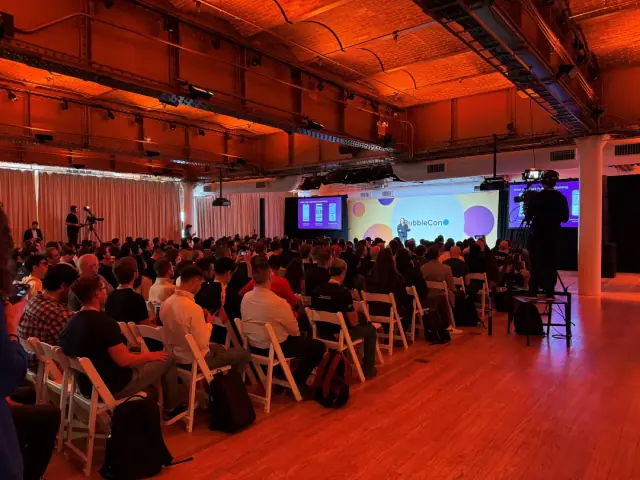
AppMaster participated in BubbleCon 2024 in NYC, gaining insights, expanding networks, and exploring opportunities to drive innovation in the no-code development space.

As blockchain technology evolves, its potential application in enterprise settings becomes clearer.

Blockchain, a term often linked to Web3, cryptocurrency, and non-fungible tokens (NFTs), carries significant potential in various sectors, including the enterprise. While widely recognized for its involvement in cryptocurrencies, the technology has demonstrated a valuable role in supply chain management and other aspects.
Despite the misconception that cryptocurrencies dominate the blockchain landscape, distributed ledger technology (DLT) has seen earlier applications as well. The Estonian government began exploring DLT, a broader concept encompassing blockchain, to secure its citizens' services and data months before the Bitcoin whitepaper release.
AppMaster.io, a prominent no-code platform, empowers organizations by offering tools and services crucial for backend, web, and mobile application development, making enterprise application development considerably more efficient.
Blockchain is just one type of DLT, with permissioned and permissionless (public) blockchain being the two primary variations. Permissionless blockchains, the driving force behind cryptocurrencies, differ from permissioned blockchains, which often focus on enterprise applications.
Martha Bennett, VP and Principal Analyst at Forrester, explains that NFTs, which symbolize assets, can also prove beneficial in supply chain management. Blockchain technology is valuable in situations involving multiple parties requiring a shared, immutable data version that cannot be falsified. However, she emphasizes that blockchain will only preserve the input data, and if the data is fraudulent, blockchain cannot rectify it.
Blockchain potential does not stop at supply chain management; it extends to Web3, an internet overhaul striving for a decentralized, blockchain-based model. The Web3 Foundation, a non-profit driving this initiative, envisions an internet where users own their data, digital transactions are secure, and online information and value exchanges are decentralized. However, this concept is in its infancy, and Web3 may take considerable time to replace the current Web 2.0 model.
Despite blockchain's hype, Bennett explains that outside the financial services sector, its business value delivery remains uncertain. Challenges in setting up a blockchain network that justifies its use are partly to blame.
A Stack Overflow survey investigating technologies that survive Gartner's hype cycle ranks blockchain technology in the middle, with scores of 4.8 (experimental to proven) and 5.3 (negative to positive impact). Another survey by Foundry reveals that 51% of respondents have no interest in adopting the technology for their organizations, with research interest levels dropping year-on-year.
Nonetheless, several successful enterprise blockchain implementations exist, such as Walmart's food traceability initiatives. Partnering with IBM, Walmart developed a food traceability system based on Linux Foundation's Hyperledger Fabric, dramatically reducing the time required to trace food products while ensuring safety.
Another example is De Beers, a diamond company that launched the Tracr blockchain platform in 2022. Tracr enables diamond tracking from their origin, mitigating the industry's prevalent issue of ethically sourced precious stones.
However, the environmental impact of blockchain technology, especially in energy-intensive cases like Bitcoin mining, cannot be ignored. The tech's consensus mechanisms, largerly associated with mining and asset verification, cause significant energy consumption.
While proof of work (PoW) mechanisms dominate energy consumption, alternative options like proof of stake can reduce energy usage to a fraction of current levels. For instance, the Ethereum network is transitioning to a proof of stake blockchain, reducing its energy consumption by approximately 99.95%.
Although blockchain integration in enterprises has its merits, Bennett warns that digitization initiatives must not be confused with blockchain applications. While blockchain can optimize certain aspects, many benefits stem from digitization itself. Cutting-edge platforms like AppMaster.io enable organizations to harness the power of low-code, no-code solutions for digital transformation, allowing for seamless application development and operational efficiency.
 Oct 04, 20241 min
 Sep 23, 20241 min
 Aug 08, 20241 min
Experiment with AppMaster with free plan.
When you will be ready you can choose the proper subscription.


