


 Jul 14, 2026
 8 min
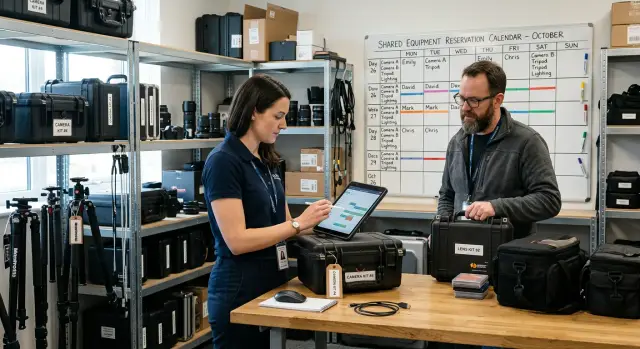
8 minEquipment reservation app: prevent conflicts and track returns
Plan an equipment reservation app that prevents double bookings, records returns and damage, and places faulty items on maintenance hold.

Webhooks vs polling: learn how each affects latency, failures, rate limits, and the retry and replay patterns that keep data in sync.

Sync sounds like “make updates show up fast,” but the real job is tougher: make two systems agree on what’s true, even when messages are late, duplicated, or missing.
With webhooks vs polling, the difference is how you learn that something changed.
A webhook is push. System A calls your endpoint when an event happens (for example, “invoice paid”). Polling is pull. Your system asks system A on a schedule, “anything new since last time?”
Keeping systems in sync usually means tracking both events and state. Events tell you what happened. State tells you what the record looks like right now. Timing matters because integrations rarely run in perfect order. An “updated” event can arrive before “created,” or arrive twice, or never arrive.
The goal is correct data, not just fresh data. “Correct” means you don’t miss changes, you don’t apply the same change twice, you can recover after downtime without manual cleanup, and you can prove what you processed and when.
A practical example: your payment provider sends a webhook like “payment_succeeded.” Your app creates an order and marks it paid. If your webhook endpoint is briefly down, you might never see that event. A polling job that asks for payments updated “since yesterday” can reconcile the gap and fix the order state.
Most real integrations end up using both: webhooks for speed, polling for backfill and verification. The method is less important than the safety rails around it.
When people compare webhooks vs polling, they often mean one thing: how quickly your app notices a change somewhere else. That freshness isn’t just a nice-to-have. It affects support tickets, duplicate work, and whether users trust what they see.
Polling has built-in delay because you only ask on a schedule. If you poll every 5 minutes, an update can arrive anywhere from a few seconds to almost 5 minutes late, plus API response time. Polling more often improves freshness, but it increases API calls, cost, and the chances you hit rate limits.
Webhooks can feel near real time because the provider pushes an event as soon as something happens. But they aren’t instant or guaranteed. Providers may batch events, retry later, or pause delivery. Your system adds delay too (queue backlogs, database locks, deploys). A more accurate expectation is: fast when things are healthy, eventually consistent when they aren’t.
Traffic shape matters. Polling gives steady, predictable load. Webhooks are bursty: a busy hour can send hundreds of events in a minute, then nothing for a while. If you accept webhooks, assume spikes and plan to queue events so you can process them at a controlled pace.
Before you design anything, pick a target freshness window:
If a sales team needs new leads to show up within 1 minute, webhooks get you there. A “safety poll” every few hours can still catch missed events and confirm the final state.
Most integrations fail in boring, repeatable ways. The surprise isn’t that something breaks. It’s that it breaks quietly. Speed is easy to argue about. Reliability is where the real work lives.
Polling failures often look like “we didn’t see the update,” even when the code seems fine. Timeouts can cut a request mid-way. Partial responses can slip through if you only check for HTTP 200 and don’t validate the body. Pagination changes are common too: an API shifts sort order, changes page rules, or moves from page numbers to cursors, and you end up skipping or re-reading items. Another classic mistake is filtering by “updated_since” using your local clock, then missing updates when clocks drift or the provider uses a different timestamp field.
Webhooks fail differently. Delivery is usually “at least once,” so providers retry on network errors and you will see duplicates. If your endpoint is down for 10 minutes, you may get a burst of old events later. Signature validation issues are also frequent: a secret rotates, you validate the wrong raw payload, or a proxy modifies headers, and suddenly valid events look invalid.
The shared failure mode in both approaches is duplicates and out-of-order delivery. Assume you will receive the same event more than once, events arriving late, events arriving out of order, and payloads missing fields you expected.
You almost never get “exactly once.” Design for “at least once,” and make handling safe. Store an idempotency key (event ID or provider object version), ignore repeats, and apply updates only if they’re newer than what you already saved. Also log what you received and what you did with it, so you can replay confidently instead of guessing.
Rate limits are where webhooks vs polling stops being a theory question and becomes a budget and reliability problem. Every extra request costs time and money, and it can damage your relationship with the provider.
Polling burns through quotas because you pay for checking even when nothing changed. It gets worse when limits are per user or per token: 1,000 customers polling every minute can look like an attack, even if each customer is “well behaved.” Polling also multiplies calls easily (list endpoints, then fetch details for each item), which is how you hit the ceiling unexpectedly.
Webhooks usually reduce API calls, but they create burst pressure. A provider might deliver thousands of events at once after an outage, bulk import, or product launch. Some will throttle you with 429s, some will retry aggressively, and some will drop events if your endpoint is slow. Your side needs backpressure: accept quickly, queue work, and process at a safe pace.
To reduce calls without losing correctness, focus on a few patterns that hold up in practice:
Plan for peaks before they happen. Keep a dedicated backfill mode that runs slower, respects quotas, and can be paused and resumed.
The webhooks vs polling choice usually comes down to this: do you need speed, or do you need a simple, predictable way to get updates even when the vendor is unreliable?
Polling is often the better default when the third party doesn’t offer webhooks, or when your workflow can tolerate a delay. It’s also easy to reason about if you only need a daily or hourly sync and the API has a clear “updated since” filter.
Webhooks are the better default when time matters: “new order received,” “payment failed,” “ticket assigned.” They reduce wasted API calls and can trigger work right away.
A practical rule is to use both when correctness matters. Let webhooks give you speed, and let polling clean up what you missed. For example, process webhooks quickly, then run a scheduled poll every 15 minutes (or every few hours) to reconcile gaps caused by dropped events or temporary outages.
A quick guide:
Before you commit, ask the vendor a few questions and get clear answers:
A “correct” sync isn’t just “data shows up.” It means the right records match, the latest change wins, and you can prove what happened when something goes wrong.
Start with a plan you can test and monitor:
When you implement this, keep the choices visible in your data model: external IDs, timestamps, status fields, and a place to store sync checkpoints. That structure is what keeps sync correct when the real world gets messy.
If you build webhooks vs polling integrations long enough, one rule shows up every time: you will see duplicates, retries, and out-of-order updates. If your sync can’t safely reprocess the same message, it will drift over time.
Idempotency means “same input, same result,” even if it arrives twice. Treat every incoming event as “maybe repeated,” and design your handler to be safe. A common pattern is: compute a dedup key, check if you already processed it, then apply changes.
Dedup keys have tradeoffs. An event ID is best when the provider gives one. If not, you can use an object version (like an incrementing revision). Timestamp windows like “ignore repeats for 10 minutes” are fragile because late arrivals do happen.
Ordering is the other half. Global ordering is rare, so aim for per-object ordering. Apply updates to a single ticket, invoice, or customer only if the version is newer than what you stored. If you have no version, use last-write-wins with a clear rule (for example, newer updated_at wins), and accept that clock skew can still create edge cases.
Store enough to recover and replay without guessing:
Example: a Stripe payment webhook arrives twice, then a “paid” update arrives before the “created” event. If you store the invoice’s latest status version and ignore older updates, you end up correct.
Most integrations fail quietly. A webhook arrives late, a polling job hits a limit, or your app times out while saving. Without retries and replay, systems slowly disagree until a customer complains.
Providers usually retry when you don’t return a successful HTTP code fast enough. Treat the webhook request as a delivery notification, not the place to do heavy work.
A practical webhook pattern:
This avoids a common trap: thinking “webhook received” means “data is synced.”
Polling fails differently. The risk is a thundering herd of retries after a short outage, which makes rate limits worse. Use exponential backoff plus jitter, and keep a “since” cursor so you don’t re-scan everything.
When you can’t process something now, put it in a dead-letter queue (or table) with the reason. That gives you a safe place to inspect, fix mapping rules, and re-run without guessing what was lost.
Replay is how you heal after missed events. A simple replay strategy:
Example: your billing provider sends “invoice.paid,” but your database was locked for 30 seconds. You dead-letter the event, then replay by re-fetching the invoice and payment status and updating your records to match.
Most sync bugs aren’t “big architecture” problems. They’re small assumptions that turn into silent drift, duplicate records, or missed updates.
A few that show up repeatedly:
Many “webhooks vs polling” debates miss the point: reliability comes from the safety rails around either method. A payment webhook can arrive twice or arrive late. If your system creates records directly on webhook without idempotency, you can message or charge a customer twice.
Day-to-day health checks look similar whether you use webhooks, polling, or both. You want to know whether data is fresh, whether errors are piling up, and whether you can recover cleanly.
A quick checklist you can run in a few minutes:
A useful habit is to periodically replay a known busy period in a controlled way and confirm the results match production.
Picture a small SaaS team that needs three systems to stay in sync: a CRM (contacts and deals), Stripe payments (charges and refunds), and a support tool (ticket status).
They use a webhook-first setup for anything that needs fast reactions. CRM events update the customer record and trigger internal tasks. Stripe webhooks create invoices, unlock features after payment, and mark accounts past due on failed charges. For the support tool, they use webhooks if available, but they also keep a scheduled poll because ticket states can change in bulk.
They treat polling as a safety net, not the main engine. Every night, a reconciliation job pulls the last 24 hours of changes across systems and compares them to what the app already stored.
Then a real-world outage happens: their webhook endpoint is down for 20 minutes during a deployment.
What they log: incoming event ID, provider timestamp, internal record ID, and the final result (created, updated, ignored). What triggers an alert: repeated webhook failures, a spike in retries, or reconciliation finding more than a small threshold of missing updates.
A practical default for most teams is simple: use webhooks for immediacy, and keep a small polling job for reconciliation. Webhooks get changes to you quickly. Polling catches what you missed because of outages, misconfigured subscriptions, or a provider that occasionally drops events.
Make the sync correct before you make it fast. Treat every incoming change as something you can safely apply more than once.
Three actions to take first:
Once it runs, monitoring is what keeps it running. Track webhook delivery rate, failures by reason (timeouts, 4xx, 5xx), and how far behind your reconciliation poll is. Alert on “no events received” as well as “too many events received.”
If you prefer to build this without hand-writing a full backend from scratch, AppMaster (appmaster.io) is a no-code option that lets you model data, create webhook endpoints, and design retry/replay flows with visual tools, while still generating real source code for deployment.
 When should I use webhooks instead of polling?
Use webhooks when your app needs to react within seconds, such as after a payment, new order, or ticket assignment. Use polling when a delay is acceptable or the provider does not offer webhooks.
Is it better to use webhooks and polling together?For important data, use both. Webhooks deliver changes quickly, while a scheduled poll checks recent records and repairs gaps after outages or missed deliveries.
Do webhooks guarantee that I will receive every update?No. Providers can retry, delay, batch, or stop delivery during an outage. Treat each webhook as an at-least-once delivery and keep a way to reconcile recent data.
How much delay does polling add?Polling delay depends on the schedule. A job that runs every five minutes may see a change almost immediately or nearly five minutes later, plus API and processing time.
How do I prevent duplicate records from webhook retries?Store a provider event ID or object version, then check it before writing. If you already processed that event or have a newer version of the record, ignore the repeat.
What should my webhook endpoint do first?Return a successful response quickly after you verify the signature and save the event. Put the heavier work in a queue or worker so slow database work does not cause unnecessary retries.
How can I avoid API rate limits with polling?Start with incremental queries, such as records updated since a saved cursor, instead of repeatedly fetching everything. Batch requests, cache stable data, and slow retries when the provider returns rate-limit errors.
What is the safest way to retry a failed polling job?Keep a checkpoint for the last successful run and retry temporary failures with exponential backoff plus random jitter. Do not advance the checkpoint until you finish processing the relevant records.
What should I do with events that keep failing?Save failed events or records with the error reason in a dead-letter queue or table. After you fix the issue, fetch the current provider state and reapply it through the same idempotent update rules.
Which metrics show whether a sync is healthy?Track sync lag, the last successful poll or event, queue backlog, retries, error rate, and API quota use. Alert when data falls outside the freshness window your users need.
Experiment with AppMaster with free plan.
When you will be ready you can choose the proper subscription.
 Jul 14, 20268 min
 Jul 13, 20268 min
 Jul 08, 20268 min