


 Jul 14, 2026
 8 min
8 minEquipment reservation app: prevent conflicts and track returns
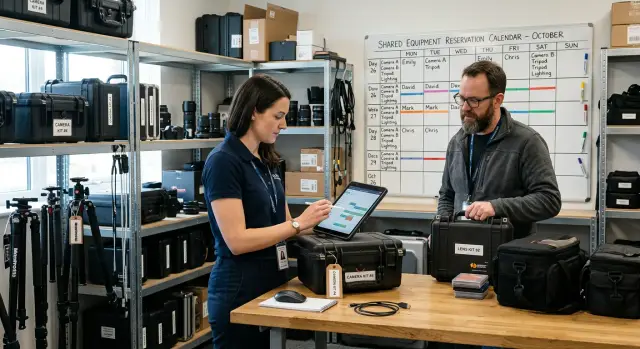
Plan an equipment reservation app that prevents double bookings, records returns and damage, and places faulty items on maintenance hold.

Build an NCR app with CAPA tasks to log defects, assign root-cause steps, set due dates, and track corrective actions through approval and closure.

A nonconformance report (NCR) is a record of something that didn’t meet a requirement. That requirement could be a drawing, a spec, a work instruction, or a customer expectation. The goal isn’t to blame anyone. It’s to capture the facts while they’re fresh so the same issue doesn’t repeat.
CAPA stands for Corrective and Preventive Action. It’s what happens after the NCR is logged: you investigate why it happened, fix the immediate problem, and put a prevention step in place. In a good system, the NCR is the trigger and CAPA is the follow-through.
Together, NCR and CAPA help with a few practical problems: capturing issues consistently, assigning clear ownership, closing work on time with due dates, keeping decisions traceable, and preventing repeats.
Common triggers are easy to spot once you look for them: a customer complaint, a failed in-process check, a final inspection reject, or a supplier issue like wrong material certs. Even near misses can be worth an NCR when the cost of repeating the mistake is high.
A simple example: a batch fails a dimension check. The NCR captures the part number, lot, measurement, photos, and who found it. CAPA then assigns root-cause analysis, corrective action (containment and fix), prevention (process change or training), and verification before closure.
An NCR is most useful when it captures only what helps someone make a decision: what happened, how big it is, and what to do next. If the form feels like a quiz, people will skip it or write “see email.”
Most teams do well with five field groups:
Attachments matter more than long text. A single photo of a cracked housing, plus the inspection note showing an out-of-tolerance measurement, can save hours later. For supplier issues, include the supplier document or certificate as an upload.
Example: a receiving inspector flags 12 units from batch B-104. The NCR records the PO, part revision, severity “high,” and containment “hold in quarantine rack Q2.” That’s enough for the next owner to start root-cause work without chasing context.
Before you create screens, agree on one simple flow everyone can follow. A clear workflow prevents two common problems: NCRs that sit in limbo and CAPAs that get opened for every small issue.
Start with a small set of statuses that match how work really moves, such as Draft, Submitted, Containment, RCA, CAPA, Verification, Closed. Keep names familiar so operators, quality, and managers read them the same way.
Decide who can move an NCR forward and make the rules explicit. For example: the reporter can save and submit, quality can accept and route it, production can complete containment tasks, supplier quality can run supplier RCA, and management can approve high-risk closure.
Add a few “gates” so the right information exists before status changes. Keep it minimal, but strict where it matters:
Also decide when to open CAPA versus closing as a minor issue. A simple rule works well: if the defect is repeated, customer-impacting, safety-related, or supplier-systemic, open CAPA. If it’s a true one-off and fully contained with low recurrence risk, close it with a short rationale.
Plan approvals early. Many teams use a lightweight chain: quality approves the NCR record, production confirms feasibility, supplier quality confirms supplier commitments, and management signs off on risk and closure.
If people don’t trust the roles and rules, they work around the system. Keep it simple: one clear owner for each NCR, and tasks that can be delegated without losing accountability.
A practical role model:
Keep ownership with one person (often Quality). Let them reassign tasks, but avoid reassigning the NCR itself unless there’s a strong reason. That makes audit questions easier to answer later.
Permissions should match real work:
An audit trail isn’t optional. Track who changed what and when for status, due dates, assignments, and key fields. Capture “why” for sensitive changes, like moving a due date.
For suppliers and external parties, keep access simple: either give limited access only to their assigned tasks, or use an internal proxy (often Supplier Quality) who records supplier updates.
Start with data. If the tables are clear, the screens get easier.
A practical core set of objects is: NCR (the report), NCR Item (what failed, where, and how many), Task (work to be done), Comment (discussion), and Attachment (photos, PDFs, measurements). One NCR usually has many items, tasks, comments, and files. Tasks should always point back to the NCR so people can move from work to context in one click.
A simple build order:
Keep Create NCR short. Capture only what’s needed to start work: part number, defect description, location, severity, detected by, date. Fill the rest on the Details page.
Use workflow rules to control status changes with basic checks. When someone submits, validate required fields, set the status, and stamp the submitted time. When someone closes, confirm all required tasks are complete and closure notes are present.
Example: an operator files an NCR for scratched housings. The supervisor opens the NCR, adds two tasks (containment and investigation), assigns owners, and attaches a photo. The record stays readable because tasks, comments, and files all live under the same NCR.
Root-cause analysis fails when it’s treated like a single text box. A better pattern is a small set of repeatable RCA task types, each with one clear outcome that someone else can verify.
Pick 3 to 5 RCA task types that fit most defects and keep them consistent:
Write tasks so they can be marked done or not done. “Investigate issue” is too vague. “Confirm torque range used on Lot 24 and attach torque log” is verifiable.
Make evidence required on every RCA task, either as an attachment or a short note. Then keep a structured “Root cause” field that forces clarity, such as: Cause (what failed), Why (what allowed it), Proof (what evidence supports it).
Add one gate that prevents premature action: RCA must be approved before CAPA tasks can start.
A useful test: if someone new can follow the evidence and reproduce the reasoning, the RCA is doing its job.
Corrective and preventive actions sound similar, but they’re different in practice. Corrective action removes the cause of this specific problem (fix now). Preventive action reduces the chance of repeats across products, lines, or sites.
Keep corrective and preventive actions separate in your NCR/CAPA app. Otherwise, teams close CAPA with a quick patch and the repeat shows up next month.
Write every action so a new person could execute it without guessing. A few fields are enough:
Verification is the immediate check: did we do what we said, and does it meet acceptance criteria? Assign a verifier who isn’t the owner when possible, and make proof required.
Effectiveness review is later: did the change hold up over time? Set a window based on risk, often 30 to 90 days. For example, if the NCR was “labels smearing after packaging,” effectiveness might be “zero smears in the last 500 units” or “no customer complaints in 60 days.”
Closure should be a rule, not a feeling. Close only when all actions are verified, the effectiveness review is completed (or formally waived with a reason), and required approvals are recorded.
Due dates only work when they feel fair. If every task is “due tomorrow,” people stop trusting the system and start ignoring it. Set sensible defaults by severity, and let owners adjust with a clear reason.
A simple starting point many teams accept:
Keep reminders quiet and predictable: one message a few days before the due date, then one on the due date. If a task is already “in progress” with a comment, avoid daily pings.
Escalation should prevent stalled risk, not shame people. Keep it tied to action:
To stop a silent backlog, make “overdue” hard to miss. Put overdue task counts on each role’s home screen: task owners see their own, NCR owners see everything they’re responsible for.
Also track cycle time so you can improve the process, not just chase dates: submitted to contained, contained to RCA, and RCA to closure.
A good dashboard makes the system feel calm. People can see what needs attention today, and managers can spot risk before it turns into a late audit finding.
Start with one NCR list that anyone can use quickly, with consistent filters across screens. Common filters include status, severity, product/process area, supplier (if applicable), and current owner.
Then add a manager view that answers three questions: What’s overdue? What’s getting old? What’s repeating? Useful tiles are overdue RCA and CAPA tasks, aging NCRs (for example, open more than 30 days), and top defect categories by count and severity. If you only track one trend, track repeat issues by category and product line.
Audit trails should be built-in. For every NCR and CAPA item, capture a history of what changed, who changed it, and when. At minimum, record status changes (including reopen events), approvals, comments and attachments, due date changes (with reason), and owner reassignments.
For cleaner reporting and easier audits, use controlled lists for severity, defect category, root-cause method, and disposition. Free-text still matters, but it shouldn’t be the only source of truth.
A receiving inspector finds that 12 of 200 stainless brackets have burrs on an edge that could cut an operator. She logs an NCR, adds photos, the supplier lot number, and tags it as a safety risk.
The quality lead reviews it the same day and makes the containment decision: quarantine the full lot, stop the work order that uses the brackets, and notify production and purchasing. A short note goes out to the floor: “Do not use lot L-4821. Parts are in Hold area A.”
Root-cause analysis starts as a small set of tasks with clear owners:
By Friday, the team agrees on a root cause statement: “Supplier changed the deburring wheel and skipped the first-piece check, allowing burrs to pass without detection.”
CAPA tasks are assigned with due dates and expected evidence:
Closure happens only after verification passes. The approver marks the CAPA “Effective,” attaches the final inspection report and the supplier’s signed checklist, and closes the NCR with a clear audit trail.
The biggest failure mode is making reporting so hard that people stop reporting. If your NCR form asks for a full root-cause story up front, you’ll get incomplete entries or nothing at all. Keep the first step focused on what happened, where, when, and who noticed it. Add deeper detail later as tasks.
A close second is ownership. When an NCR is assigned to “the team,” it usually means “no one.” Every record needs one named owner at each stage, even if several people contribute.
Unclear rules create chaos. If severity is a feeling, similar defects get handled differently and audits get messy. Define severity levels with simple examples, and be explicit about when CAPA is required (repeat issues, customer impact, safety risk, or process breakdown).
A few mistakes that quietly break NCR/CAPA tracking:
Another common gap is closing items based on activity, not results. “Action completed” isn’t the same as “effectiveness verified.” Make verification a required step with a clear pass/fail outcome.
A simple NCR app with CAPA tasks works best when every record answers: what happened, who owns it, what’s due next, and what proof shows it’s fixed.
Keep your first build focused:
Start small with a pilot on one line, one site, or one product family for 2 to 3 weeks. You’ll learn which fields people skip, which statuses confuse them, and where handoffs break.
Decide early where the app will run. Cloud is usually fastest for a pilot. Exported source code or self-hosting may fit teams with strict IT or data rules, but it’s easier if you choose that before you lock in notifications and access rules.
If you’re building on AppMaster, you can model NCRs, tasks, owners, and due dates as straightforward data objects, then use visual workflows to enforce gates like “RCA approved before CAPA starts.” For teams that want to test quickly with real users, AppMaster (appmaster.io) is a practical way to build and iterate without writing code.
 What’s the difference between an NCR and a CAPA?
An NCR (nonconformance report) captures the facts of what didn’t meet a requirement, while CAPA is the follow-through that investigates the cause, fixes the issue, and prevents repeats. A practical default is: log the NCR as soon as the defect is found, then open CAPA only when the issue is repeated, high risk, customer-impacting, safety-related, or clearly systemic.
When should I create an NCR instead of just fixing the issue on the spot?Write it when you have a clear nonconformance and enough info to identify the item and scope, even if you don’t know the cause yet. If it’s a near miss but the cost of repeating it would be high, logging an NCR is usually worth it because it creates traceability and ownership.
What are the most important fields to include in an NCR?Start with what someone needs to act: where it was found, what item failed (part/revision/lot), what the defect is, how many are affected, severity, and what immediate containment was done. Keep it short at creation time so people actually submit it, then add investigation and action detail as tasks on the record.
What’s a simple NCR-to-CAPA workflow that won’t confuse people?A simple workflow is enough: Draft, Submitted, Containment, RCA, CAPA, Verification, Closed. The key is to require containment before RCA starts, and require an approved root cause before CAPA tasks can begin, so actions are based on evidence instead of guesses.
Who should own an NCR and who should do the tasks?Assign one named owner for the NCR end-to-end, commonly someone in Quality, so accountability is clear. Other people can own tasks for containment, RCA steps, or actions, but the single NCR owner keeps the record moving and makes audit questions easier to answer.
How do you set permissions so the system is trusted and not worked around?Lock the core facts after submission so the record stays trustworthy, but allow comments and attachments so people can add context. A good rule is: reporters can’t change key fields after submitting; assignees can edit only their tasks; the NCR owner controls status and due dates; approvers must comment when rejecting a gate.
How do we stop root-cause analysis from turning into vague text?Make evidence mandatory at the task level, not buried in one big text box. Require a photo, measurement log, updated document, or a short note that can be verified, and include a structured root cause statement that explains what failed, why it was allowed to fail, and what proof supports that conclusion.
Why should corrective and preventive actions be tracked separately?Corrective action fixes the specific problem now, while preventive action reduces the chance of the same failure showing up again elsewhere. Keeping them separate forces clarity, so you can tell what contained and fixed today’s issue versus what changed the system to prevent repeat defects.
How should we set due dates, reminders, and escalation without annoying everyone?Use default timelines based on severity and allow changes only with a reason. Reminders should be predictable and limited, and escalation should trigger action like confirming a new due date or notifying the NCR owner, rather than sending constant pings that everyone ignores.
What’s the quickest way to build an NCR app with CAPA tasks in AppMaster?Start small with a core data model like NCR, NCR Items, Tasks, Comments, and Attachments, then build three screens: list, create, and details. In AppMaster, you can model these as data objects and use visual workflows to enforce gates such as “containment recorded before RCA” and “RCA approved before CAPA starts,” which helps you pilot quickly without writing code.
Experiment with AppMaster with free plan.
When you will be ready you can choose the proper subscription.
 Jul 14, 20268 min
 Jul 13, 20268 min
 Jul 08, 20268 min