


 Jul 14, 2026
 8 min
8 minEquipment reservation app: prevent conflicts and track returns
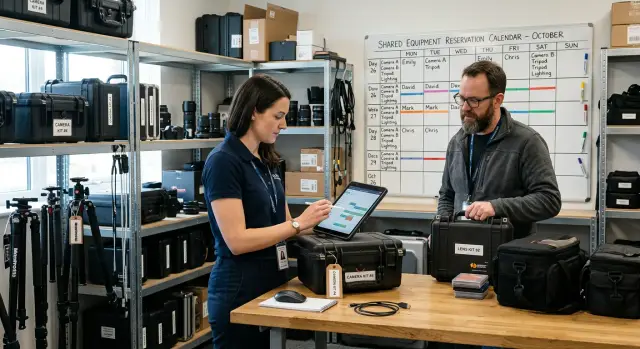
Plan an equipment reservation app that prevents double bookings, records returns and damage, and places faulty items on maintenance hold.

Message templates for reminders you can copy for bookings, late payments, pickups, and follow-ups, with clear timing, tone, and quick personalization tips.

A reminder is a short message that helps someone do something they already agreed to: show up, pay, pick up, confirm, or reply. It’s not the same as a policy update. If you’re changing rules, adding fees, or introducing a new deadline, that’s a separate message and should be labeled clearly as an update.
A quick way to tell the difference:
Reminders often feel rude for three simple reasons: tone, timing, and missing details. A message can be polite and still annoy people if it shows up too often, too late, or with vague wording like “please handle ASAP.” People read that as blame.
Missing details cause most of the back-and-forth. If the recipient has to search for the date, the amount, or where to go, they may ignore the message or reply with questions. That delay makes you want to send another reminder, and the cycle starts.
The goal with reminder templates isn’t to sound extra friendly. It’s to reduce confusion and make the next action easy: one clear step, one clear deadline (if there is one), and the exact info they need to act.
A simple rule helps: clarity first, friendliness second. Start with the facts, then add a human line.
For example:
“You still haven’t paid. Please pay immediately.” feels accusatory.
“Hi Sam, quick reminder that invoice #104 is due tomorrow (Jan 26) for $120. You can pay by card or bank transfer. If you already sent it, thanks - you can ignore this.” says the same thing without the sting or the confusion.
When your reminders consistently include the key details and a single next step, you send fewer follow-ups and get faster responses without sounding harsh.
A reminder sounds human when it answers the reader’s questions in the same order they appear in their head: Who is this, what is this about, when is it happening (or due), and what do you want me to do next?
A structure you can reuse:
Name + purpose -> key detail -> time or due date -> next step -> easy reply.
If you keep those parts in that order, your messages stay clear even when the situation changes.
Start with the person’s name (if you have it) and one plain line about what the message is about. Then add the key detail right away, before the date and time. People scan for the thing that makes the reminder “theirs.”
Good key details to put near the top include location or address (appointments, pickups), an order or booking number (deliveries, reservations), the amount due and invoice number (payments), a time window (service visits), or what to bring (documents, ID).
Then add the time or due date, followed by the next step. Keep the next step to one action, not a menu of options.
If you want fewer confusing replies, offer a reply format that works on any phone keyboard. “Reply YES to confirm” beats “Please confirm at your earliest convenience.”
A few simple patterns:
Only include contact info when the reader may genuinely need it (changes, questions, access issues). If the next step is a quick confirmation, adding phone numbers, extra lines, and long signatures can distract from the action you want.
To keep it short without sounding abrupt, add one friendly sentence that signals you’re helpful, not robotic: “If anything changed, tell me and we’ll adjust.”
Personalization works when it feels like you noticed the person, not like you merged fields. The easiest win is their name plus one real detail that matters right now, like the appointment time or the pickup location. More than that can feel creepy or noisy.
Instead of: “Hi {FirstName}, just a reminder about your booking.”
Try: “Hi Sam - quick reminder: your haircut is booked for Tue at 3:00 PM.”
Tone matters as much as the details. Pick one tone for the situation and stick to it across your reminder templates, so customers learn what to expect.
Words can accidentally add blame. “Overdue” and “failed” can be useful in final notices, but in early reminders they often trigger defensiveness. Swap in neutral phrases like “still open,” “not yet received,” or “pending” until you truly need stronger language.
Adding a reason can help, as long as it sets expectations and doesn’t sound like an excuse. “So we can hold your slot” explains why you’re asking for confirmation. “To avoid a late fee” explains the consequence without lecturing.
Your style should stay consistent, too. If you rarely use emojis, one random smiley can feel fake. Same with punctuation. If your brand voice is calm and direct, keep it that way: one exclamation mark at most, and avoid ALL CAPS.
A simple way to keep messages human is to personalize only what changes:
Example: “Hi Jordan - your order is ready for pickup at Oak Street. We’re open until 6 PM today. Reply if you need us to hold it for tomorrow.”
If you’re building your booking or billing workflow in a tool like AppMaster, it helps to store only the fields you actually use in messages (name, appointment time, amount due, due date). That keeps personalization accurate and avoids awkward, overly detailed texts.
These message templates for reminders are written to sound like a real person: clear, short, and easy to act on. Swap in the details in brackets.
Use a friendly tone if you already have a relationship with the customer. Use the neutral version when you want to stay more formal.
24-hour reminder (friendly)
Hi [Name] - quick reminder of your [service] tomorrow at [time] at [location]. If you need to move it, just reply here.

24-hour reminder (neutral)
Hello [Name]. This is a reminder of your [service/appointment] on [date] at [time] at [location]. Reply to reschedule.

2-hour reminder (friendly)
Hi [Name] - see you at [time] for your [service]. If you’re running late, reply with your ETA.

2-hour reminder (neutral)
Reminder: your [appointment] is at [time] today. If you are delayed, please reply with an updated arrival time.

Confirmation request (reply YES)
Hi [Name] - can you confirm your [appointment] on [date] at [time]? Reply YES to confirm or NO to reschedule.

Reschedule (offer two options)
No problem - would [Option 1] or [Option 2] work better for your [service]? If not, tell me a day/time that usually works.

No-show prevention (respectful)
If something changed and you can’t make it, please reply to reschedule. It helps us keep the time open for someone else.
A small detail that helps: include one action (confirm, reschedule, ETA) and one channel (reply here). Avoid adding extra questions.
24-hour reminder (reservation)
Hi [Name], your reservation is set for [date] at [time] for [party size]. Reply CONFIRM to confirm or CHANGE to adjust.

2-hour reminder (reservation)
Hi [Name], we’re expecting you at [time]. If you’re running late, reply with your ETA.

Confirmation request (simple)
Please reply YES to confirm your booking for [date] at [time]. If you need to change it, reply NO.

Reschedule (simple question)
Do you want to keep your booking at [time], or move it to a later time?

No-show prevention (polite, clear)
If you can’t make it today, please let us know so we can release the spot. Reply CANCEL to cancel.
These late payment reminder messages are written to sound human: calm first, then clearer and firmer if needed. Swap in the details in {brackets}.
1) Gentle nudge before the due date (pre-due)
“Hi {Name} - quick note that {invoice #/your balance} of {amount} is due on {date}. If you’ve already scheduled it, you can ignore this. Need anything from me?”
“Hi {Name}, reminder that your payment for {service/order} is due {date}. If this timing doesn’t work, reply and we’ll sort out a plan.”
2) 1-3 days late (assume it was missed)
“Hi {Name}, I think this may have been missed - {amount} was due on {date}. When you get a moment, could you take care of it and confirm?”
“Hi {Name} - just following up. I’m still seeing {invoice #} for {amount} unpaid. If you’ve paid already, please tell me the date so I can match it.”
3) 7+ days late (firm but polite, clear deadline)
“Hi {Name}, this is a reminder that {amount} is now {X} days overdue (due {date}). Please make payment by {new deadline date}. If there’s an issue, reply today so we can agree on next steps.”
“Hi {Name}. We need to close out {invoice #} for {amount}. Please pay by {deadline} or reply with a payment date. If I don’t hear back, we’ll have to pause {service/account} until it’s resolved.”
4) Payment plan or partial payment
“Hi {Name}, if paying the full {amount} is hard right now, we can do {option A} and {option B}. Which works for you, and what date should I note?”
“Hi {Name} - would a partial payment of {partial amount} today and the rest on {date} work? Reply ‘yes’ and I’ll confirm the plan in writing.”
5) Receipt and confirmation (after payment is received)
“Thanks, {Name} - I received {amount} on {date}. Your balance is now {balance}. Want a receipt emailed to {email}?”
“Payment confirmed - thank you. {Invoice #} is now marked paid. If you need anything updated on your account, just reply here.”
Pickup messages work best when they answer the three questions people always have: Where do I go, when can I come, and what do I need to bring?
Before you copy a template, fill in these placeholders (you can keep them in your saved message templates for reminders):
TEMPLATE 1 (friendly + clear)
Hi [Name], your [item/order] is ready for pickup.
Location: [Pickup location]
Hours: [Hours]
Please bring: [ID and/or order #].
Reply if you need a different pickup time.

TEMPLATE 2 (short + practical)
Hi [Name] - your [item/order] is ready.
Pick up at [Pickup location] during [Hours].
Bring [order #] (and [ID] if needed).

TEMPLATE 3 (ID required)
Hi [Name], your [item/order] is ready for pickup at [Pickup location].
For pickup, we need: [government ID] + [order #].
Hours: [Hours]. Thanks!
TEMPLATE 4 (same-day reminder)
Hi [Name], quick reminder: your [item/order] is ready for pickup today.
We’re open [Hours]. Address: [Pickup location].
Bring [order #/ID].

TEMPLATE 5 (return-by date, calm tone)
Hi [Name], reminder about your pickup for [item/order].
Please pick up by [Date] to keep it reserved.
Location: [Pickup location], hours: [Hours].
If you can’t make it, reply and we’ll help with options.

TEMPLATE 6 (storage fee, clear and neutral)
Hi [Name], your [item/order] is ready at [Pickup location] (hours: [Hours]).
Just a heads-up: after [Date], storage is [fee] per [day/week].
If you need more time, reply and we’ll confirm what we can do.

TEMPLATE 7 (missed pickup, offer delivery alternative)
Hi [Name], we missed you today. Your [item/order] is still ready at [Pickup location].
Next pickup times: [Hours/days].
If pickup is tough, we can switch to delivery for [fee/ETA]. Want to do that?

TEMPLATE 8 (needs order number at pickup)
Hi [Name], your [item/order] is ready for pickup.
Please have your order number ready: [Order #].
Location: [Pickup location]. Hours: [Hours].
If you want fewer back-and-forth replies, add one line that invites a simple answer, like: “Reply with a time window that works (example: 3-5pm).”
These follow-ups work best when they have one purpose: confirm, clarify, or offer a simple next step. Swap in the brackets, keep the tone plain, and send from a real name when possible.
Use placeholders like:
After-visit (thank you + next step)
Hi [Name], thanks for coming in today. If anything feels off after [service/appointment], just reply to this message and we’ll help.
Thanks again, [Name]. Your next step is [next step]. If you want, I can also book your next visit for [two options].
Quote follow-up (help them decide, not pressure them)
Hi [Name], checking in on the quote for [project/item]. Do you want me to adjust anything (timing, options, budget), or is it all set?
Quick note on your quote [Quote #]. If it helps, I can recommend the simplest option for your situation. Want me to?
Support ticket follow-up (confirm solved, offer help)
Hi [Name], did this fix the issue from ticket [#]? If not, tell me what you’re seeing now (even a quick sentence is fine).
Just checking: are you all set now? If yes, I’ll close ticket [#]. If you need more help, reply here and we’ll keep going.
Review request (no guilt, easy exit)
Hi [Name], thanks again for choosing us. If you have 30 seconds, we’d love a short review of your experience. If not, no worries at all.
How did we do on [service/order #]? A quick note (good or bad) helps us improve. If you’d rather reply with feedback instead of a review, you can just text me back.
Reactivation (inactive customers, one clear offer)
Hi [Name], it’s been a while. If you still need help with [need], we have an opening on [two options]. Want me to hold a spot?
Hey [Name], checking in. If you’d like to restart [service/subscription], I can set you up with [one clear offer]. Want details?
Keep the ask small. Instead of “Let us know if you have questions,” ask one thing they can answer fast: “Is the timing still good?” or “Do you want option A or B?”
If you’re building reminder wording into a workflow, keep the same message across channels (SMS, email, chat) so customers don’t get mixed signals. The goal is fewer back-and-forth messages, not more.
A good reminder isn’t “nice.” It’s easy to act on. If someone has to reread it or ask a question, the template needs tightening.
Start from a real message you’ve sent before, then edit it in this order:
After that, make channel versions. SMS should be short and direct. Email can include one extra line of context (like the policy or what happens next). Chat can be slightly more conversational, but still action-first.
Here’s a quick example transformation:
Original: “Hi! Just checking in because we haven’t heard back and we want to make sure everything is okay. Your appointment is coming up soon and we need to confirm. Let us know when you can!”
Template: “Hi {Name} - reminder: {Service} on {Day} at {Time} at {Location}. Reply YES to confirm or NO to reschedule.”
If you send reminders from a tool you manage (for example, an internal app built in AppMaster), save each template with placeholders like {Name} and {DueDate}, plus separate SMS and email versions. That way the wording stays consistent even when the details change.
Most reminder problems aren’t about wording. They’re about missing or messy details that force the other person to reply just to understand what you mean.
The biggest issue is leaving out the one thing the person needs to act: the exact time, the amount due, or the pickup location. If your message makes someone ask, “Which booking is this?” or “How much is left?” you’ve created extra work for both sides.
A reminder can be firm without sounding like an accusation. Phrases like “You still haven’t paid” often trigger defensiveness, even when the person simply forgot. A neutral tone works better: state the fact, include the detail, and offer a clear next step.
Be careful with legal-sounding lines and heavy punctuation. ALL CAPS, multiple exclamation marks, and threats (“FINAL NOTICE”) can feel hostile and make a normal situation feel like a dispute.
Vague timing is another common blocker. “ASAP” and “soon” are unclear. A date, a time window, or “by end of day Tuesday” is easier to follow and reduces back-and-forth.
Also watch your reminder pace. Too many messages too fast can annoy people and increase no-shows. A simple spacing rule is to send one reminder, then wait long enough for a reasonable response. For example, a booking reminder the day before, then a short follow-up a few hours before. For late payments, a gentle nudge after the due date, then a second reminder a few days later.
Quick fixes you can apply to most reminder templates:
A small example: if you write, “Reminder: your invoice is overdue, please pay ASAP,” expect questions. If you write, “Hi Sam, quick reminder: Invoice #104 is $120 due by Tue, Jan 30. Reply if you need the link resent,” most people can act immediately.
Before you send any reminder, do a 10-second scan. Most confusion comes from vague first lines, too many options, or missing details.
If you change only one thing, make the next step obvious. People rarely ignore reminders, they ignore unclear ones.
Salon booking reminder:
“Hi Maya, quick reminder of your haircut on Tue 14 May at 3:30 PM. Reply YES to confirm, or send a new time that works for you.”
Late invoice:
“Hi Chris, checking in on invoice #1042 for $240, due last Friday. Can you pay today, or tell me the day you plan to pay?”
Pickup notice:
“Hi Jordan, your order is ready for pickup at Oak Street. We’re open today until 6 PM. Reply PICKUP and the time you’re coming so we can have it at the counter.”
Notice what stays the same: clear topic first, one action, and the important detail (time, amount, or hours) is impossible to miss.
Once you have a few message templates for reminders that work, treat them like a small system, not random texts.
Store templates in one place and label them by situation (booking, payment, pickup, follow-up) and channel (SMS, email). Test two tones for a week: “warm and casual” vs “short and direct,” then keep the one that gets faster replies.
If you want to automate the boring parts, build a simple reminders workflow: save customer details, trigger a message when a booking is created or an invoice becomes overdue, and log replies so you know what happened without chasing threads. AppMaster (appmaster.io) is one way to build that kind of internal tool without writing code, while keeping your templates consistent across SMS and email.
 How do I make a reminder sound less cold without making it overly friendly?
Start with the facts in the first line (what this is about and the key detail), then add one human sentence. Keep it to one clear next step, like confirming, paying, or replying with an ETA.
When is a message a reminder vs a policy update?Use a reminder when the plan is already agreed and you’re nudging the next step. If the rules, fees, or deadline changed, label it as an update so people don’t feel blindsided or blamed.
What’s the one detail I should put at the top of a reminder?Lead with the detail that makes it “theirs,” such as the appointment time, invoice number and amount, or pickup location. If they have to search for those basics, they’ll delay or reply with questions.
Should I say “ASAP” or give a specific deadline?Replace vague words like “ASAP” or “soon” with a specific date or time window. A clear deadline reduces back-and-forth and makes the reminder feel more fair.
How often should I send reminders without annoying people?A reliable default is one message with enough time to act, then one closer to the event if needed. Too many reminders too fast can feel like pressure and can make people ignore later messages.
What’s the best way to ask for confirmation in a reminder?Use a reply shortcut that works on any keyboard, like “Reply YES to confirm” or “Reply NO to reschedule.” This makes the next action obvious and reduces long, confusing replies.
How do I escalate late payment reminders without sounding aggressive?Start neutral and factual, then get firmer only after time has passed. Early messages should assume it was missed, while later messages can include a clear deadline and what happens next if there’s no response.
How much personalization is too much in reminder messages?Stick to name plus one real, relevant detail like time, location, or invoice amount. Avoid adding extra personal data or too many merged fields, because it can feel fake or creepy.
What words make reminders feel accusatory, and what should I use instead?Use simple, factual language and remove blame words like “still” or “ignored.” A firm reminder can be direct while staying respectful if it states what’s pending and what you want them to do next.
How can I set up automated reminders in an internal tool without messy templates?Store only the fields you actually use in messages, then generate reminders from a consistent template so details don’t drift. In AppMaster, a common approach is to keep customer, booking, and invoice fields structured and trigger the right template when the status changes, so every reminder stays clear and consistent.
Experiment with AppMaster with free plan.
When you will be ready you can choose the proper subscription.
 Jul 14, 20268 min
 Jul 13, 20268 min
 Jul 08, 20268 min