


 Jul 14, 2026
 8 min
8 minEquipment reservation app: prevent conflicts and track returns
Plan an equipment reservation app that prevents double bookings, records returns and damage, and places faulty items on maintenance hold.

Idempotent payment webhooks checklist for deduping events, handling retries, and safely updating invoices, subscriptions, and entitlements.
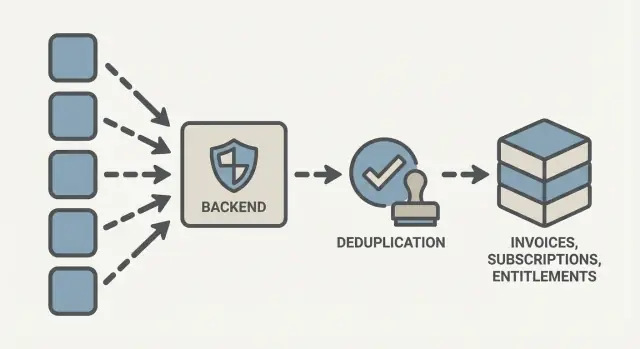
A payment webhook is a message your payment provider sends to your backend when something important happens, like a charge succeeds, an invoice is paid, a subscription renews, or a refund is issued. It’s basically the provider saying, “Here’s what happened. Update your records.”
Duplicates happen because webhook delivery is designed to be reliable, not exactly once. If your server is slow, times out, returns an error, or is briefly unavailable, the provider will usually retry the same event. You can also see two different events that refer to the same real-world action (for example, an invoice event and a payment event tied to one payment). Events can arrive out of order too, especially with fast follow-ups like refunds.
If your handler isn’t idempotent, it can apply the same event twice, which turns into problems customers and finance teams notice right away:
This isn’t just “best practice.” It’s the difference between billing that feels dependable and billing that creates support tickets.
The goal of this checklist is simple: treat each incoming event as “apply at most once.” You’ll store a stable identifier for every event, handle retries safely, and update invoices, subscriptions, and entitlements in a controlled way. If you’re building the backend in a no-code tool like AppMaster, the same rules still apply: you need a clear data model and a repeatable handler flow that stays correct under retries.
Idempotency means processing the same input more than once produces the same final state. In billing terms: one invoice ends up paid once, one subscription updates once, and access is granted once, even if the webhook is delivered twice.
Providers retry when your endpoint times out, returns a 5xx, or the network drops. Those retries repeat the same event. That’s different from a separate event that represents a real change, like a refund days later. New events have different IDs.
To make this work, you need two things: stable identifiers and a small “memory” of what you’ve already seen.
Most payment platforms include an event ID that’s unique to the webhook event. Some also include a request ID, idempotency key, or a unique payment object ID (like a charge or payment intent) inside the payload.
Store what helps you answer one question: “Have I already applied this exact event?”
A practical minimum:
The key move is to store the event ID in a table with a unique constraint. Then your handler can do this safely: insert event ID first; if it already exists, stop and return 200.
Keep dedupe records long enough to cover late retries and support investigations. A common window is 30 to 90 days. If you deal with chargebacks, disputes, or longer subscription cycles, keep them longer (6 to 12 months), and purge old rows so the table stays fast.
In a generated backend like AppMaster, this maps cleanly to a simple WebhookEvents model with a unique field on the event ID, plus a business process that exits early when a duplicate is detected.
A good webhook handler is mostly a data problem. If you can record each provider event exactly once, everything that follows gets safer.
Start with one table that acts like a receipt log. In PostgreSQL (including when modeled in AppMaster’s Data Designer), keep it small and strict so duplicates fail fast.
Here’s a practical baseline for a webhook_events table:
provider (text, like "stripe")provider_event_id (text, required)status (text, like "received", "processed", "failed")processed_at (timestamp, nullable)raw_payload (jsonb or text)Add a unique constraint on (provider, provider_event_id). That single rule is your main dedupe guardrail.
You’ll also want the business IDs you use to locate records to update. These are different from the webhook event ID.
Common examples include customer_id, invoice_id, and subscription_id. Keep them as text because providers often use non-numeric IDs.
Store the raw payload so you can debug and reprocess later. Parsed fields make queries and reporting easier, but only store what you actually use.
A simple approach:
raw_payloadevent_type (text) for filteringIf an invoice.paid event arrives twice, your unique constraint blocks the second insert. You still have the raw payload for audits, and the parsed invoice ID makes it easy to locate the invoice record you updated the first time.
A safe handler is boring on purpose. It behaves the same way every time, even when the provider retries the same event or delivers events out of order.
Verify the signature and parse the payload. Reject requests that fail signature checks, have an unexpected event type, or can’t be parsed.
Write the event record before touching billing data. Save the provider event ID, type, created time, and the raw payload (or a hash). If the event ID already exists, treat it as a duplicate and stop.
Map the event to a single “owner” record. Decide what you’re updating: invoice, subscription, or customer. Store external IDs on your records so you can look them up directly.
Apply a safe state change. Only move state forward. Don’t undo a paid invoice because a late “invoice.updated” arrives. Record what you applied (old state, new state, timestamp, event ID) for audit.
Respond quickly and log the outcome. Return success once the event is safely stored and either processed or ignored. Log whether it was processed, deduped, or rejected, and why.
In AppMaster, this usually becomes a database table for webhook events plus a Business Process that checks “seen event ID?” and then runs the minimal update steps.
Providers retry webhooks when they don’t get a fast success response. They may also send events out of order. Your handler needs to stay safe when the same update arrives twice, or a later update arrives first.
One practical rule: reply fast, do the work later. Treat the webhook request as a receipt, not a place to run heavy logic. If you call third-party APIs, generate PDFs, or recalculate accounts inside the request, you increase timeouts and trigger more retries.
Out-of-order delivery is normal. Before applying any change, use two checks:
If you already recorded an invoice as paid and a late “open” event arrives, ignore it. If you received “canceled” and later an older “active” update appears, keep canceled.
Ignore an event when you can prove it’s stale or already applied (same event ID, older timestamp, lower status priority). Queue an event when it depends on data you don’t have yet, like a subscription update arriving before the customer record exists.
A practical pattern:
In AppMaster, this is a good fit for a webhook events table plus a Business Process that acknowledges the request quickly and processes queued events asynchronously.
Once you’ve handled deduplication, the next risk is split billing state: the invoice says paid, but the subscription is still past due, or access was granted twice and never revoked. Treat every webhook as a state transition and apply it in one atomic update.
Invoices can move through states like paid, voided, and refunded. You may also see partial payments. Don’t “toggle” an invoice based on whatever event arrived last. Store the current status plus key totals (amount_paid, amount_refunded) and only allow forward-safe transitions.
Practical rules:
amount_refunded up to the invoice total; never decrease it.Subscriptions include renewals, cancellations, and grace periods. Keep subscription status and period boundaries (current_period_start/end), then derive entitlement windows from that data. Entitlements should be explicit records, not a single boolean.
For access control:
Apply invoice, subscription, and entitlement updates in a single database transaction. Read current rows, check whether this event was already applied, then write all changes together. If anything fails, roll back so you don’t end up with “paid invoice” but “no access,” or the reverse.
In AppMaster, this often maps well to a single Business Process flow that updates PostgreSQL in one controlled path and writes an audit entry alongside the business change.
Webhook security is part of correctness. If an attacker can hit your endpoint, they can try to create fake “paid” states. Even with deduplication, you still need to prove the event is real and keep customer data safe.
Validate the signature on every request. For Stripe, that typically means checking the Stripe-Signature header, using the raw request body (not a rewritten JSON), and rejecting events with an old timestamp. Treat missing headers as a hard failure.
Validate basics early: correct HTTP method, Content-Type, and required fields (event id, type, and the object id you’ll use to locate an invoice or subscription). If you build this in AppMaster, keep the signing secret in environment variables or secure config, never in the database or client code.
A quick security checklist:
Log enough to debug retries and disputes, but avoid sensitive values. Store a safe subset of PII: provider customer ID, internal user ID, and maybe a masked email (like a***@domain.com). Never store full card data, full addresses, or raw authorization headers.
Log what helps you reconstruct what happened:
Add basic abuse protection: rate limit by IP and (when possible) by customer ID, and consider allowing only known provider IP ranges if your setup supports it.
Most billing bugs aren’t about math. They happen when you treat a webhook delivery like a single, reliable message.
Mistakes that most often lead to duplicated updates:
A simple example: a renewal event arrives twice. The first delivery creates an entitlement row. The retry creates a second row, and your app sees “two active entitlements” and grants extra seats or credits.
In AppMaster, the fix is mostly about flow: verify first, insert the event record with a unique constraint, apply billing updates with state checks, and push side effects (emails, receipts) to async steps so they can’t trigger a retry storm.
This pattern looks scary, but it’s manageable if your handler is safe to rerun.
A customer is on a monthly plan. Stripe sends a renewal event (for example, invoice.paid). Your server receives it, updates the database, but takes too long to return a 200 response (cold start, busy database). Stripe assumes it failed and retries the same event.
On the first delivery, you grant access. On the retry, you detect it’s the same event and do nothing. Later, a refund event arrives (for example, charge.refunded) and you revoke access once.
Here’s a simple way to model state in your database (tables you can build in AppMaster Data Designer):
webhook_events(event_id UNIQUE, type, processed_at, status)invoices(invoice_id UNIQUE, subscription_id, status, paid_at, refunded_at)entitlements(customer_id, product, active, valid_until, source_invoice_id)After Event A (renewal, first delivery): webhook_events gets a new row for event_id=evt_123 with status=processed. invoices is marked paid. entitlements.active=true and valid_until moves forward one billing period.
After Event A again (renewal, retry): insertion into webhook_events fails (unique event_id) or your handler sees it already processed. No changes to invoices or entitlements.
After Event B (refund): a new webhook_events row for event_id=evt_456. invoices.refunded_at is set and status=refunded. entitlements.active=false (or valid_until is set to now) using source_invoice_id to revoke the right access once.
The important detail is timing: the dedupe check happens before any grant or revoke writes.
Before you turn on live webhooks, you want proof that one real-world event updates billing records exactly once, even if the provider sends it twice (or ten times).
Use this checklist to validate your setup end to end:
You don’t need a big observability setup to start, but you do need signals. Track these from logs or simple dashboards:
If you’re building this in AppMaster, keep event storage in a dedicated table in the Data Designer and make “mark processed” a single, atomic decision point in your Business Process.
Testing is where idempotency proves itself. Don’t only run the happy path. Replay the same event several times, send events out of order, and force timeouts so your provider retries. The second, third, and tenth delivery should change nothing.
Plan for backfilling early. Sooner or later you’ll want to reprocess past events after a bug fix, schema change, or provider incident. If your handler is truly idempotent, backfilling becomes “replay events through the same pipeline” without creating duplicates.
Support also needs a small runbook so issues don’t turn into guesswork:
If you want to implement this without writing a lot of boilerplate, AppMaster (appmaster.io) lets you model the core tables and build the webhook flow in a visual Business Process, while still generating real source code for the backend.
Try building the webhook handler end to end in a no-code generated backend and keep it safe under retries before you scale traffic and revenue.
 Why does my payment provider send the same webhook more than once?
Duplicate webhook deliveries are normal because providers optimize for at least once delivery. If your endpoint times out, returns a 5xx, or briefly drops the connection, the provider will resend the same event until it gets a successful response.
What’s the best way to dedupe webhook events?Use the provider’s unique event ID (the webhook event identifier), not the invoice amount, timestamp, or customer email. Store that event ID with a unique constraint so a retry can be detected immediately and safely ignored.
Should I save the event before updating billing records?Insert the event record first, before you update invoices, subscriptions, or entitlements. If the insert fails because the event ID already exists, stop processing and return success so retries don’t create double updates.
How long should I keep webhook dedupe records?Keep them long enough to cover delayed retries and to support investigations. A practical default is 30–90 days, and longer (like 6–12 months) if you deal with disputes, chargebacks, or long subscription cycles, then purge older rows to keep queries fast.
Do I really need signature verification if I already dedupe events?Verify the signature before touching billing data, then parse and validate required fields. If signature verification fails, reject the request and do not write billing changes, because deduplication won’t protect you from forged “paid” events.
How do I handle webhook timeouts without creating duplicates?Prefer to acknowledge receipt quickly after the event is safely stored, and move heavier work to background processing. Slow handlers trigger more timeouts, which causes more retries, which increases the chance of duplicate updates if anything isn’t fully idempotent.
What should I do when events arrive out of order?Only apply changes that move state forward, and ignore stale events. Use event timestamps when available and a simple status priority (for example, refunded should not be overwritten by paid, and canceled should not be overwritten by active).
How can I avoid granting access twice when a renewal webhook is retried?Don’t create a new entitlement row on every event. Use an upsert-style rule like “ensure one entitlement per user/product/period (or per subscription)”, then update dates/limits, and record which event ID caused the change for auditing.
Why should invoice and entitlement updates be in one transaction?Write invoice, subscription, and entitlement changes in a single database transaction so they succeed or fail together. This prevents split states like “invoice paid” but “no access granted,” or “access revoked” without a matching refund record.
Can I implement this safely in AppMaster without writing custom backend code?Yes, and it’s a good fit: create a WebhookEvents model with a unique event ID, then build a Business Process that checks “already seen?” and exits early. Model invoices/subscriptions/entitlements explicitly in the Data Designer so retries and replays don’t create duplicate rows.
Experiment with AppMaster with free plan.
When you will be ready you can choose the proper subscription.
 Jul 14, 20268 min
 Jul 13, 20268 min
 Jul 08, 20268 min