


 Jul 14, 2026
 8 min
8 minEquipment reservation app: prevent conflicts and track returns
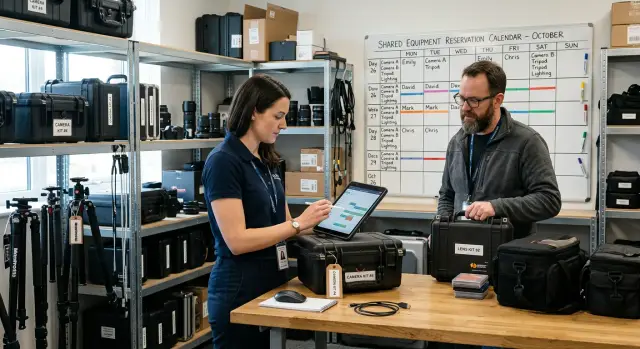
Plan an equipment reservation app that prevents double bookings, records returns and damage, and places faulty items on maintenance hold.

Learn when gRPC streaming vs REST polling is the better choice, with clear examples for live dashboards and progress updates, plus mobile and firewall notes.

Polling means the client asks the server for updates again and again, usually on a timer (every 1 second, 5 seconds, 30 seconds).
Streaming means the client opens one connection and the server keeps sending updates as they happen, without waiting for the next request.
That single difference is why streaming and polling can feel similar in a small demo but behave very differently in a real product. With polling, you choose a tradeoff up front: faster updates mean more requests. With streaming, you keep a line open and send only when something actually changes.
In practice, a few things tend to shift:
Polling is only as fresh as the interval you picked, while streaming can feel near-instant. Polling also creates lots of "nothing changed" responses, which adds cost on both sides (requests, headers, auth checks, parsing). On mobile, frequent polling keeps the radio awake more often, which can burn battery and data. And because polling samples the state, it can miss quick changes between intervals, while a well-designed stream can deliver events in order.
A simple example is a live operations dashboard showing new orders and their status. Polling every 10 seconds may be fine on a slow day. But when the team expects updates within 1 second, polling either feels laggy or starts hammering the server.
Not every app needs real-time. If users check a page once in a while (like monthly reports), polling every minute, or just refreshing on demand, is often the simplest and best choice.
Polling feels straightforward: the client asks, "anything new?" every N seconds. It works when updates are rare, the user count is small, or being a few seconds late doesn't matter.
The pain starts when you need frequent freshness, lots of users, or both.
Live dashboards are the classic case. Think of an ops screen showing open tickets, payment failures, and red alerts. If the numbers change every few seconds, polling either lags (users miss spikes) or it hammers your API (your servers spend time answering "no change" over and over).
Progress updates are another common trap. File uploads, report generation, and video processing often run for minutes. Polling every second makes the UI look "live," but it creates a lot of extra requests and still feels jumpy because the client only sees snapshots.
Unpredictable arrivals also make polling wasteful. Chat, support queues, and new orders can be quiet for 10 minutes, then burst for 30 seconds. With polling, you pay the cost during the quiet time, and you still risk delays during the burst.
IoT-style signals push it further. When you track device online or offline status, last seen, and small metrics, you can have thousands of tiny changes that add up. Polling multiplies that into a steady stream of requests.
Polling is usually starting to hurt when you see patterns like these: teams lower the interval to 1 to 2 seconds just to look responsive; most responses contain no updates but still burn through headers and auth; server load grows with open tabs instead of real change; mobile users complain about battery and data; traffic spikes happen when people open dashboards, not when business events happen.
The main win of streaming is simple: you stop asking the server the same question over and over when the answer is usually "no change." With polling, your app keeps sending requests on a timer just to find out that nothing new happened. That creates wasted traffic, extra parsing, and more chances for timeouts.
With streaming, the server keeps one connection open and pushes new data only when something changes. If an order status updates, a metric crosses a threshold, or a background job moves from 40% to 41%, the update can show up right away instead of waiting for the next polling window.
That lower latency isn't only about speed. It changes how the UI feels. Polling often produces visible "jumps": a spinner appears, data refreshes in bursts, and numbers snap forward. Streaming tends to produce smaller, more frequent updates, which reads as smoother and more trustworthy.
Streaming can also make server work easier to reason about. Polling often returns a full response each time, even if 99% of it is identical to the last response. With a stream, you can send only the changes, which can mean fewer bytes, fewer repeated database reads, and less repeated serialization.
In practice, the contrast looks like this: polling creates many short requests that often return "nothing new"; streaming uses one longer-lived connection and sends messages only when needed. Polling latency is tied to the interval you chose (2 seconds, 10 seconds, and so on). Streaming latency is tied to the event itself (update happens, user sees it). Polling responses are often full snapshots, while streams can send small deltas.
Back to the live ticket dashboard example: with polling every 5 seconds, you either waste calls during quiet periods or accept that the dashboard is always a few seconds behind. With streaming, quiet periods are actually quiet, and when a ticket arrives the UI can update immediately.
When people picture streaming, they often imagine one big "live connection" that magically solves everything. In practice, teams use a few simple patterns, each matching a different kind of update.
This is the most common pattern: the client opens one call and the server keeps sending new messages as they happen. It fits any screen where users watch things change.
A live ops dashboard is a clear example. Instead of the browser asking "any new orders?" every 2 seconds, the server pushes an update the moment a new order arrives. Many teams also send occasional heartbeat messages so the UI can show "connected" and detect broken connections faster.
The same idea applies to progress updates. If a report takes 3 minutes, the server can stream milestones (queued, 10%, 40%, generating PDF, done) so the user sees movement without spamming the server.
Here the client sends a lot of small events efficiently on one call, and the server responds once at the end (or only with a final summary). It's useful when you have bursts of data.
Think of a mobile app capturing sensor readings or a POS app buffering offline actions. When the network is available, it can stream a batch of events with less overhead than hundreds of separate REST requests.
This is for ongoing conversations where both sides can talk at any time. A dispatcher tool can send commands to a field app while the app streams status back. Live collaboration (multiple users editing the same record) can also fit.
Request-response is still the best choice when the result is a single answer, updates are rare, or you need the simplest path through caches, gateways, and monitoring.
Start by writing down what truly needs to change on the screen right away and what can wait a few seconds. Most products only have a small "hot" slice: a live counter, a progress bar, a status badge.
Split updates into two buckets: real-time and "good enough later." For example, a support dashboard might need new tickets to appear immediately, but weekly totals can refresh every minute without anyone noticing.
Then name your event types and keep each update small. Don't send the whole object every time if only one field changes. A practical approach is to define events like TicketCreated, TicketStatusChanged, and JobProgressUpdated, each with just the fields the UI needs to react.
A useful design flow:
Reconnect behavior is where many teams get stuck. A solid default is: on connect, send a snapshot (current state), then send incremental events. If you support resume, include a cursor like "last event id" so a client can ask, "send me anything after 18452." That keeps reconnects predictable.
Backpressure is just the "what if the client can't keep up?" problem. For a live dashboard, it's often fine to collapse updates. If progress moves 41%, 42%, 43% while the phone is busy, you can send only 43%.
Also plan a fallback that keeps the product usable. Common choices are a temporary switch to polling every 5 to 15 seconds, or a manual refresh button for less critical screens.
If you're building in AppMaster, this often maps neatly to two paths: an event-driven flow for the "hot" updates and a standard API read for the fallback snapshot.
Picture a warehouse dashboard that shows inventory levels for 200 SKUs. With REST polling, the browser might call /inventory every 5 seconds, receive a full JSON list, and repaint the table. Most of the time, nothing changed, but you still pay the cost: repeated requests, repeated full responses, and repeated parsing.
With streaming, the flow flips. The client opens one long-lived stream. It first receives an initial snapshot (so the UI can render immediately), then only small updates when something changes.
A typical dashboard view becomes:
Now add a second screen: a long-running job, like importing a CSV or generating monthly invoices. Polling often produces awkward jumps: 0%, 0%, 0%, 80%, done. Streaming makes it feel honest and calm.
A progress stream usually sends small, frequent snapshots:
A key design choice is deltas vs snapshots. For inventory, deltas are great because they're tiny. For job progress, snapshots are often safer because each message is already small, and it reduces confusion if a client reconnects and misses a message.
If you build apps in a platform like AppMaster, this typically maps to a read model (initial state) plus event-like updates (deltas), so the UI stays responsive without hammering your API.
On a phone, a "continuous connection" behaves differently than it does on a desktop. Networks switch between Wi-Fi and cellular, tunnels reset, and users walk into elevators. The big shift is that you stop thinking in single requests and start thinking in sessions that can disappear at any moment.
Expect disconnects and design for safe replays. A good stream includes a cursor like "last event id" so the app can reconnect and say, "resume from here." Without that, users see duplicate updates (the same progress step twice) or missing updates (jumping from 40% to 90%).
Battery life often improves with streaming because the app avoids constant wakeups to poll. But that only holds if messages are small and meaningful. Sending whole objects every second is a fast way to burn data and battery. Prefer compact events like "order 183 status changed to Shipped" instead of re-sending the entire order.
When the app is in the background, streaming is often paused or killed by the OS. Plan a clear fallback: show the last known state, then refresh on foreground. For urgent events, use platform push notifications and let the app open and re-sync when the user taps.
A practical approach for mobile dashboards and progress updates:
If you build mobile apps with AppMaster, treat the stream as "nice when available," not "the only source of truth." The UI should stay usable during short disconnects.
Streaming can look like a clear win on paper, until real networks get involved. The big difference is the connection: streaming often means one long-lived HTTP/2 connection, and that can upset corporate proxies, middleboxes, and strict security setups.
Corporate networks sometimes use TLS inspection (a proxy that decrypts and re-encrypts traffic). That can break HTTP/2 negotiation, block long-lived streams, or quietly downgrade behavior in ways that are hard to spot. Symptoms show up as random disconnects, streams that never start, or updates arriving in bursts instead of smoothly.
HTTP/2 support is non-negotiable for classic gRPC. If a proxy only speaks HTTP/1.1, calls may fail even though normal REST works fine. That's why browser-like environments often need gRPC-Web, which is designed to pass through more common HTTP infrastructure.
Even when the network allows HTTP/2, infrastructure often has idle timeouts. A stream that stays quiet for a while can be closed by a load balancer or proxy.
Common fixes:
If users sit behind locked-down corporate networks, treat streaming as best-effort and provide a fallback channel. A common split is to keep gRPC streaming for native apps, but allow gRPC-Web (or short REST polls) when the network behaves like a browser proxy.
Test from the same places your users work:
If you deploy with AppMaster to AppMaster Cloud or a major cloud provider, validate these behaviors end-to-end, not just in local development.
The biggest trap is treating streaming as the default. Real-time feels good, but it can quietly raise server load, mobile battery use, and support tickets. Start by being strict about which screens truly need updates within seconds and which can refresh every 30 to 60 seconds.
Another common mistake is sending the full object on every event. A live dashboard that pushes a 200 KB JSON blob every second will feel real-time right until the first busy hour. Prefer small deltas: "order 4832 status changed to shipped" instead of "here are all orders again."
Security gets missed more often than people admit. With long-lived streams, you still need strong authentication and authorization checks, and you need to plan for token expiry mid-stream. If a user loses access to a project, the server should stop sending updates immediately.
Reconnect behavior is where many apps break in the real world, especially on mobile. Phones move between Wi-Fi and LTE, go to sleep, and get backgrounded. A few habits prevent the worst failures: assume disconnects; resume from a last-seen event id (or timestamp); make updates idempotent so retries don't duplicate actions; set clear timeouts and keepalive settings for slow networks; offer a degraded fallback mode (less frequent refresh) when streaming fails.
Finally, teams ship streaming without visibility. Track disconnect rate, reconnect loops, message lag, and dropped updates. If your job progress stream shows 100% on the server but clients are stuck at 70% for 20 seconds, you need metrics that show where the delay is (server, network, or client).
Decide what "real-time" actually means for your users.
Start with latency. If a dashboard needs to feel live, updates under 1 second can justify a stream. If users only need a refresh every 10 to 60 seconds, simple polling often wins on cost and simplicity.
Then look at fan-out. A single data feed watched by many people at once (an ops dashboard on a wall screen plus 50 browsers) can turn polling into constant background load. Streaming can cut repeated requests, but you still need to handle many open connections.
A quick decision checklist:
Also think about failure and recovery. Streaming is great when it works, but the hard part is reconnects, missed events, and keeping the UI consistent. A practical design is to use streaming for the fast path, but define a resync action (one REST call) that rebuilds current state after reconnect.
If you're prototyping a dashboard quickly (for example, with a no-code UI in AppMaster), you can apply this checklist early so you don't overbuild the backend before you understand the update needs.
Treat streaming like something you earn, not a switch you flip. Pick one place where freshness is clearly worth it, and keep everything else as-is until you have data.
Start with a single high-value stream, such as job progress updates for a long task (file import, report generation) or one card on a live dashboard (today's orders, active tickets, current queue length). Keeping the scope small also makes it easier to compare against polling with real numbers.
A simple pilot plan:
Keep the fallback on purpose. Some corporate networks, older proxies, or strict firewalls interfere with HTTP/2, and mobile networks get unstable when the app goes to background. A graceful downgrade avoids blank screens and support tickets.
If you want to ship this without heavy custom code, AppMaster (appmaster.io) can help you build backend logic, APIs, and UI quickly, then iterate as requirements change. Start small, prove the value, and add streams only where they clearly beat polling.
 When should I use gRPC streaming instead of REST polling?
Use gRPC streaming when users need changes within about a second, such as new orders, ticket alerts, or job progress. Use REST polling when updates can wait 10 to 60 seconds or users rarely open the screen.
What is the main difference between streaming and polling?Polling sends requests on a timer, even when nothing changed. Streaming keeps a connection open and sends an update when an event happens, so users usually see changes sooner with less repeated request overhead.
Is streaming a good fit for live dashboards?A live dashboard benefits when people act on new tickets, payment failures, inventory changes, or queue sizes right away. Send an initial snapshot when the page opens, then send small updates only for rows or counters that changed.
Should I stream file upload or report progress?Yes. A progress stream can send the current percentage, current step, and final result as a task runs. This avoids repeated status requests and gives users a smoother view of long imports, reports, or processing jobs.
How do I know when polling is causing problems?Polling can work if the interval is long and few people use the page. It starts causing trouble when teams reduce the interval to one or two seconds, most responses contain no changes, or server load grows with open browser tabs.
How should a mobile app handle stream disconnects?Plan for disconnects from the start. Keep a last-seen event ID or cursor, reconnect with a short backoff, fetch a fresh snapshot when needed, and make duplicate events safe for the app to apply.
Does streaming save mobile battery?It can, because the app avoids waking the network radio for frequent timer-based requests. The benefit disappears if the stream sends large objects too often, so keep messages small and batch low-priority updates.
What happens to a stream when a mobile app goes into the background?Apps often pause or lose long connections in the background. Show the last known state, refresh when the user returns, and use push notifications for urgent events instead of relying on a background stream.
Why do firewalls and proxies sometimes break gRPC streaming?Some proxies and load balancers close quiet long-lived connections or do not support HTTP/2 correctly. Test corporate networks, VPNs, public Wi-Fi, and mobile carriers, then provide a polling fallback if the stream cannot stay connected.
What is the safest way to introduce streaming?Start with a small pilot, such as one job-progress screen or one live dashboard card. Track message delay, reconnects, open connections, and client behavior, then expand only if the stream improves the user experience.
Experiment with AppMaster with free plan.
When you will be ready you can choose the proper subscription.
 Jul 14, 20268 min
 Jul 13, 20268 min
 Jul 08, 20268 min