


 Jul 14, 2026
 8 min
8 minEquipment reservation app: prevent conflicts and track returns
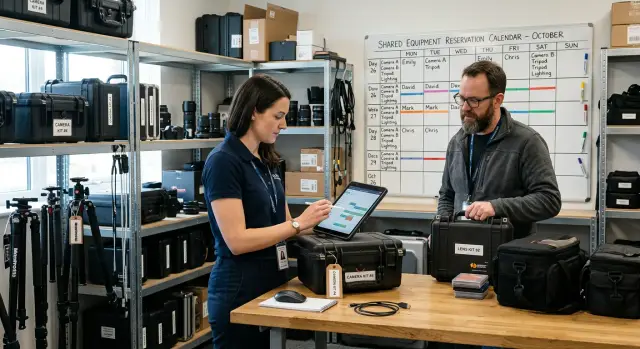
Plan an equipment reservation app that prevents double bookings, records returns and damage, and places faulty items on maintenance hold.

B2B organizations and teams database schema: a practical relational pattern for invitations, membership states, role inheritance, and audit-ready changes.

Most B2B apps aren’t really “user accounts” apps. They’re shared workspaces where people belong to an organization, split into teams, and get different permissions depending on their job. Sales, support, finance, and admins need different access, and that access changes over time.
A too-simple model breaks quickly. If you keep one users table with a single role column, you can’t express “the same person is an Admin in one org, but a Viewer in another.” You also can’t handle common cases like contractors who should only see one team, or an employee who leaves a project but still belongs to the company.
Invites are another frequent source of bugs. If an invitation is just an email row, it becomes unclear whether the person is “in” the org yet, which team they’re supposed to join, and what happens if they sign up with a different email. Small inconsistencies here tend to turn into security problems.
This pattern aims for four goals:
The promise is a single relational model that stays understandable as features grow: multiple orgs per user, multiple teams per org, predictable role inheritance, and audit-friendly changes. It’s a structure you can implement today and extend later without rewriting everything.
If you want a schema that’s still readable after six months, start by agreeing on a few words. Most confusion comes from mixing “who someone is” with “what they can do.”
An Organization (org) is the top tenant boundary. It represents the customer or business account that owns data. If two users are in different orgs, they should not see each other’s data by default. That one rule prevents a lot of accidental cross-tenant access.
A Team is a smaller group inside an org. Teams model real working units: Sales, Support, Finance, or “Project A.” Teams don’t replace the org boundary; they live under it.
A User is an identity. It’s the person’s login and profile: email, name, password or SSO ID, and maybe MFA settings. A user can exist without access to anything yet.
A Membership is the access record. It answers: “This user belongs to this org (and optionally this team) with this status and these roles.” Keeping identity (User) separate from access (Membership) makes contractors, offboarding, and multi-org access much easier to model.
Plain meanings you can use in code and UI:
Treat membership as a small state machine, not a boolean. Typical states are invited, active, suspended, and removed. This keeps invitations, approvals, and offboarding consistent and auditable.
A good multi-tenant schema starts with one idea: store “who belongs where” in one place, and keep everything else as supporting tables. That way you can answer basic questions (who is in the org, who is in a team, what can they do) without hopping across unrelated models.
Core tables you usually need:
Keep keys and constraints strict. Use surrogate primary keys (UUIDs or bigints) for each table. Add foreign keys such as teams.organization_id -> organizations.id and memberships.user_id -> users.id. Then add a few unique constraints to stop duplicates before they show up in production.
Rules that catch most bad data early:
unique(organizations.slug)unique(teams.organization_id, teams.name)unique(memberships.organization_id, memberships.user_id)unique(team_memberships.team_id, team_memberships.user_id)Decide what’s append-only versus updatable. Organizations, teams, and users are updatable. Memberships are often updatable for current state (active, suspended), but changes should also write to an append-only access log so audits are straightforward later.
The easiest way to keep access clean is to treat an invitation as its own record, not a half-made membership. A membership means “this user currently belongs.” An invitation means “we offered access, but it isn’t real yet.” Keeping them separate avoids ghost members, half-created permissions, and “who invited this person?” mysteries.
For memberships, use a small set of states you can explain to anyone:
Many teams avoid a membership state of “invited” and instead keep “invited” strictly in the invitations table. That tends to be cleaner: membership rows exist only for users who actually have access (active), or who used to have it (suspended/removed).
B2B apps often invite by email when no user account exists yet. Store the email on the invitation record, along with where the invite applies (org or team), the intended role, and who sent it. If the person later signs up with that email, you can match pending invitations and let them accept.
When an invite is accepted, handle it in one transaction: mark the invitation as accepted, create the membership, and write an audit entry (who accepted, when, and which email was used).
Define clear invitation end states:
Prevent duplicate invites by enforcing “only one pending invite per org or team per email.” If you support re-invites, either extend the expiry on the existing pending invite or revoke the old one and issue a new token.
Most B2B apps need two levels of access: what someone can do in the organization as a whole, and what they can do inside a specific team. Mixing these into one role field is where apps start to feel inconsistent.
Org-level roles answer questions like: can this person manage billing, invite people, or see all teams? Team-level roles answer: can they edit items in Team A, approve requests in Team B, or only view?
Role inheritance is easiest to live with when it follows one rule: an org role applies everywhere unless a team explicitly says otherwise. That keeps behavior predictable and reduces duplicate data.
A clean way to model this is to store role assignments with a scope:
role_assignments: user_id, org_id, optional team_id (NULL means org-wide), role_id, created_at, created_byIf you want “one role per scope,” add a unique constraint on (user_id, org_id, team_id).
Then effective access for a team becomes:
Look for a team-specific assignment (team_id = X). If it exists, use it.
Otherwise, fall back to the org-wide assignment (team_id IS NULL).
For least-privilege defaults, pick a minimal org role (often “Member”) and don’t give it hidden admin powers. New users shouldn’t get implicit team access unless your product truly needs it. If you do auto-grant, do it by creating explicit team memberships, not by quietly widening the org role.
Overrides should be rare and obvious. Example: Maria is an org “Manager” (can invite, see reports), but in the Finance team she should be “Viewer.” You store one org-wide assignment for Maria, plus one team-scoped override for Finance. No permission copying, and the exception is visible.
Role names work well for common patterns. Use explicit permissions only when you have true one-offs (like “can export but cannot edit”), or when compliance needs a clear list of allowed actions. Even then, keep the same scope idea so the mental model stays consistent.
If your app stores only the current role on a membership row, you lose the story. When someone asks, “Who gave Alex admin access last Tuesday?” you have no reliable answer. You need change history, not just current state.
The simplest approach is a dedicated audit log table that records access events. Treat it as an append-only journal: you never edit old audit rows; you only add new ones.
A practical audit table usually includes:
actor_user_id (who made the change)subject_type and subject_id (membership, team, org)action (invite_sent, role_changed, membership_suspended, team_deleted)occurred_at (when it happened)reason (optional free text like “contractor offboarding”)To capture “before” and “after,” store a small snapshot of the fields you care about. Keep it limited to access-control data, not full user profiles. For example: before_role, after_role, before_state, after_state, before_team_id, after_team_id. If you prefer flexibility, use two JSON columns (before, after), but keep the payload small and consistent.
For memberships and teams, soft delete is usually better than hard delete. Instead of removing the row, mark it disabled with fields like deleted_at and deleted_by. This keeps foreign keys intact and makes it easier to explain past access. Hard delete can still make sense for truly temporary records (like expired invites), but only if you’re sure you won’t need them later.
With this in place, you can answer common compliance questions quickly:
Start simple: one place to say who belongs to what, and why. Build it in small steps, and add rules as you go so the data can’t drift into “almost correct.”
A practical order that works well in PostgreSQL and other relational databases:
Create organizations and teams, each with a stable primary key (UUID or bigint). Add teams.organization_id as a foreign key, and decide early whether team names must be unique inside an org.
Keep users separate from membership. Put identity fields in users (email, status, created_at). Put “belongs to org/team” in a memberships table with user_id, organization_id, optional team_id (if you model it that way), and a state column (active, suspended, removed).
Add invitations as its own table, not a column on membership. Store organization_id, optional team_id, email, token, expires_at, and accepted_at. Enforce uniqueness for “one open invite per org + email + team” so you don’t create duplicates.
Model roles with explicit tables. A simple approach is roles (admin, member, etc.) plus role_assignments that point to either org scope (no team_id) or team scope (team_id set). Keep inheritance rules consistent and testable.
Add an audit trail from day one. Use an access_events table with actor_user_id, target_user_id (or email for invites), action (invite_sent, role_changed, removed), scope (org/team), and created_at.
After these tables exist, run a couple of basic admin queries to validate reality: “who has org-wide access?”, “which teams have no admins?”, and “which invites are expired but still open?” Those questions tend to reveal missing constraints early.
A schema stays sane when the database, not just your code, enforces tenant boundaries. The simplest rule is: every tenant-scoped table carries org_id, and every lookup includes it. Even if someone forgets a filter in the app, the database should resist cross-org connections.
Start with foreign keys that always point “within the same org.” For example, if you store team membership separately, a team_memberships row should reference a team_id and a user_id, but also carry org_id. With composite keys, you can enforce that the referenced team belongs to the same org.
Constraints that prevent the most common problems:
(org_id, user_id) with a partial condition for active rows (where supported).(org_id, team_id, email) where state = 'pending'.invite_token.teams.org_id NOT NULL with a foreign key to orgs(id).ended_at (and optionally ended_by) to protect audit history.Index the queries your app runs all the time:
(org_id, user_id) for “what orgs is this user in?”(org_id, team_id) for “list members of this team”(invite_token) for “accept invite”(org_id, state) for “pending invites” and “active members”Keep org names movable. Use an immutable orgs.id everywhere, and treat orgs.name (and any slug) as editable fields. Renaming then touches one row.
Moving a team between orgs is usually a policy decision. The safest option is to forbid it (or clone the team) because memberships, roles, and audit history are org-scoped. If you must allow moves, do it in a single transaction and update all child rows that carry org_id.
To prevent orphan records when users leave, avoid hard deletes. Disable the user, end their memberships, and restrict deletes on parent rows (ON DELETE RESTRICT) unless you truly want cascading removal.
Imagine a company called Northwind Co with one org and two teams: Sales and Support. They hire a contractor, Mia, to help with Support tickets for one month. This is where the model should stay predictable: one person, one org membership, optional team memberships, and clear states.
An org admin (Ava) invites Mia by email. The system creates an invitation row tied to the org, with status pending and an expiry date. Nothing else changes yet, so there’s no “half user” with unclear access.
When Mia accepts, the invitation is marked accepted, and an org membership row is created with state active. Ava sets Mia’s org role to member (not admin). Then Ava adds a Support team membership and assigns a team role like support_agent.
Now add one twist: Ben is a full-time employee with an org role of admin, but he should not see Support data. You can handle that with a team-level override that explicitly downgrades his team role for Support while keeping his org-wide admin abilities for org settings.
A week later, Mia violates policy and is suspended. Instead of deleting rows, Ava sets Mia’s org membership state to suspended. Team memberships can stay in place but become ineffective because the org membership is not active.
Audit history stays clean because each change is an event:
support_agentWith this model, the UI can show a clear access summary: org status (active or suspended), org role, team list with roles and overrides, and a “Recent access changes” feed that explains why someone can or cannot see Sales or Support.
Most access bugs come from “almost right” data models. The schema looks fine at first, then edge cases pile up: re-invites, team moves, role changes, and offboarding.
A common trap is mixing invitations and memberships in one row. If you store “invited” and “active” in the same record without clear meaning, you end up asking impossible questions like “Is this person a member if they never accepted?” Keep invitations and memberships separate, or make the state machine explicit and consistent.
Another frequent mistake is putting a single role column on the user table and calling it done. Roles are almost always scoped (org role, team role, project role). A global role forces hacks like “user is admin for one customer, but read-only for another,” which breaks multi-tenant expectations and creates support headaches.
Traps that usually hurt later:
A quick example: a contractor is invited to an org, joins Team Sales, then gets removed and re-invited a month later. If you overwrite the old row, you lose history. If you allow duplicates, they may end up with two active memberships. Clear states, scoped roles, and the right constraints prevent both.
Before you code, do a quick pass over your model and see if it still makes sense on paper. A good multi-tenant access model should feel boring: the same rules apply everywhere, and “special cases” are rare.
A fast checklist to catch common gaps:
Pressure-test the design with real questions. If you can’t answer these with one query and a clear rule, you probably need a constraint or an extra state:
Write down what admins and support staff must understand: membership states (and what triggers them), who can invite/remove, what role inheritance means in plain language, and where to look for audit events during an incident.
Implement constraints first (uniques, foreign keys, allowed transitions), then build business logic around them so the database helps keep you honest. Keep policy decisions (inheritance on/off, default roles, invite expiry) in config tables rather than code constants.
If you want to build this without hand-writing every backend and admin screen, AppMaster (appmaster.io) can help you model these tables in PostgreSQL and implement invite and membership transitions as explicit business processes, while still generating real source code for production deployments.
 Why shouldn’t I store a single role column on the users table?
Use a separate membership record so roles and access are tied to an org (and optionally a team), not to the global user identity. That lets the same person be an Admin in one org and a Viewer in another without hacks.
Should an invite create a membership row right away?Keep them separate: an invitation is an offer with an email, scope, and expiry, while a membership means the user actually has access. This avoids “ghost members,” unclear status, and security bugs when emails change.
What membership states should I use?A small set like active, suspended, and removed is enough for most B2B apps. If you keep “invited” only in the invitations table, memberships stay unambiguous: they represent current or past access, not pending access.
How do I model org roles vs team roles without confusion?Store org roles and team roles as assignments with a scope (org-wide when team_id is null, team-specific when it’s set). When checking access for a team, prefer the team-specific assignment if it exists, otherwise fall back to the org-wide one.
What’s the simplest rule for role inheritance?Start with one predictable rule: org roles apply everywhere by default, and team roles override only when explicitly set. Keep overrides rare and visible so people can explain access without guessing.
How do I prevent duplicate invites and re-invite cleanly?Enforce “only one pending invite per org/team per email” with a unique constraint and a clear pending/accepted/revoked/expired lifecycle. If you need re-invites, update the existing pending invite or revoke it before issuing a new token.
How do I enforce the tenant boundary in the database?Every tenant-scoped row should carry org_id, and your foreign keys/constraints should prevent mixing orgs (for example, a team referenced by a membership must belong to the same org). This reduces the blast radius of missing filters in application code.
How do I make access changes audit-friendly?Keep an append-only access event log that records who did what, to whom, when, and at what scope (org or team). Record the key before/after fields (role, state, team) so you can answer “who granted admin last Tuesday?” reliably.
Should I hard-delete memberships and invites?Avoid hard deletes for memberships and teams; mark them ended/disabled so history remains queryable and foreign keys don’t break. For invites, you can keep them too (even if expired) if you want a full security trail, but at minimum don’t reuse tokens.
What indexes matter most for this schema?Index your hot paths: (org_id, user_id) for org membership checks, (org_id, team_id) for team member lists, (invite_token) for invite acceptance, and (org_id, state) for admin screens like “active members” or “pending invites.” Indexes should reflect your real queries, not every column.
Experiment with AppMaster with free plan.
When you will be ready you can choose the proper subscription.
 Jul 14, 20268 min
 Jul 13, 20268 min
 Jul 08, 20268 min